
Rescue & Emergency
Vehicle Control Systems
Smarter Controls for Rescue & Emergency Vehicles
Rescue and emergency vehicles are expected to perform in urgent, high-pressure environments where reliability, visibility, and fast response matter. Fire trucks, ambulances, rescue squads, and mobile command vehicles must coordinate lighting, power distribution, operator interfaces, body equipment, diagnostics, communications support, and mission-specific functions without adding unnecessary electrical complexity.
HED helps rescue and emergency vehicle OEMs build rugged, scalable CAN-based control architectures that simplify integration, improve diagnostics, and support more advanced vehicle functionality across demanding vocational platforms.
Whether you build fire apparatus, emergency medical vehicles, rescue squads, or mobile command vehicles, HED can help reduce electrical complexity while supporting coordinated vehicle control, operator feedback, service visibility, and future-ready platform growth.
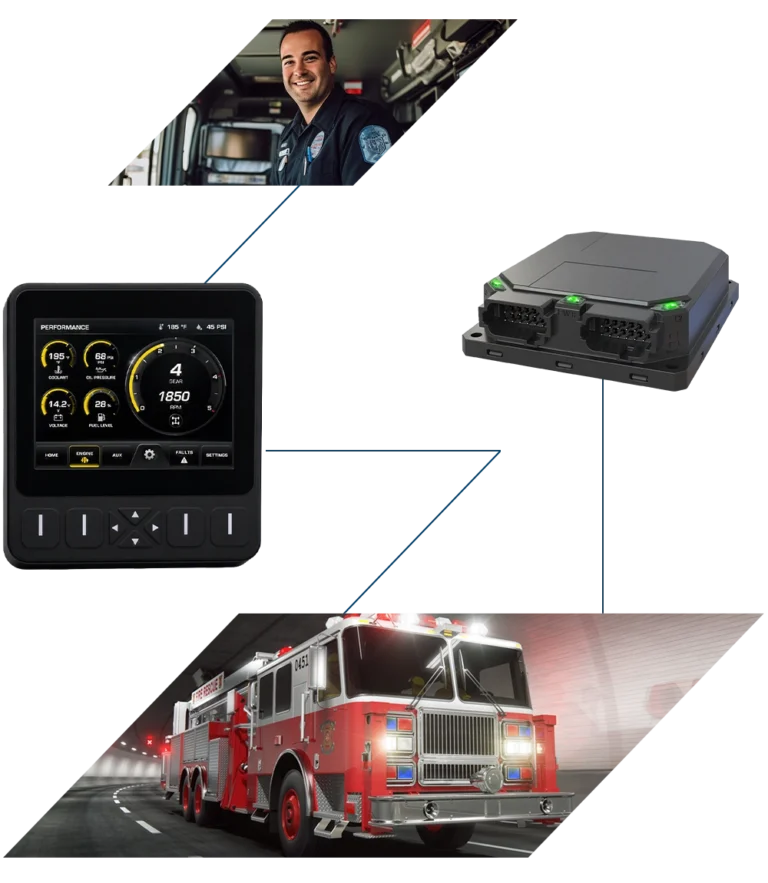
Four Controls Challenges Facing Rescue & Emergency Vehicle OEMs
Rescue and emergency vehicle OEMs are not simply adding switches, displays, lights, and outputs. Engineering teams are focused on coordinating multiple mission-critical systems that must work together reliably in fast-moving field conditions.
- HED helps OEMs address four core challenges:
- Keeping mission-critical vehicle systems ready in harsh emergency-response environments
- Improving diagnostics, fault isolation, and fleet serviceability
- Coordinating growing emergency vehicle power loads and operator feedback
- Integrating new technologies without redesigning the entire electrical architecture
Emergency vehicles have to be ready before the call comes in, during response, and throughout scene operation. Fire trucks, ambulances, rescue squads, and mobile command vehicles depend on electrical systems that can withstand harsh duty cycles while keeping mission-critical functions available.
For OEM engineers, the challenge is designing a controls foundation that supports dependable operation across lighting, warning, power, body, and operator-interface systems without adding unnecessary failure points.
Common Engineering Challenges
- Design for vibration, moisture, temperature swings, washdown, corrosion, road exposure, and repeated duty cycles
- Reduce excess wiring, splices, connectors, and relay logic that can create service risk over the life of the vehicle
- Maintain reliable control of warning lights, scene lighting, power distribution, interlocks, body equipment, and operator feedback
- Support mission-critical readiness across fire apparatus, EMS vehicles, rescue squads, and mobile command platforms
Risk to OEMs
- When reliability depends on too many hardwired connections, overloaded circuits, or poorly organized control logic, a small electrical issue can become a readiness problem for departments and fleets that cannot afford downtime.
Learn more about mission-critical vehicle readiness for rescue and emergency platforms.
Emergency fleets need service teams to move quickly from symptom to source. When a vehicle fault affects lighting, body controls, power circuits, sensors, displays, or operator interfaces, technicians need clear diagnostic visibility instead of time-consuming wire tracing.
A more serviceable controls architecture can help departments, dealers, and fleet technicians identify issues faster, reduce repeat troubleshooting, and return vehicles to service with greater confidence.
Common Engineering Challenges
- Provide clearer visibility into inputs, outputs, power circuits, communication status, and fault conditions
- Shorten troubleshooting cycles for wiring, sensor, module, keypad, display, and body-equipment issues
- Support service teams with organized diagnostics instead of relying only on manual inspection or point-to-point wire tracing
- Improve maintainability across departments, dealers, fleet shops, and field-service environments
Risk to OEMs
- If faults are difficult to isolate, even minor electrical issues can create long service events, higher warranty exposure, repeat technician visits, and lower customer confidence in the vehicle platform.
Explore how smarter diagnostics can support faster fleet service and maintenance.
Emergency vehicles carry more electrically demanding equipment than ever, from warning and scene lighting to patient-area systems, communication support, tool power, pump-related controls, HVAC interfaces, auxiliary outputs, and onboard electronics.
OEMs need a coordinated strategy for power distribution, load prioritization, operator feedback, and control logic so critical functions remain visible, manageable, and protected as vehicle requirements expand.
Common Engineering Challenges
- Manage high electrical loads from lighting, pumps, HVAC-related interfaces, medical or rescue equipment, communication systems, and auxiliary power
- Coordinate load-shedding, power-mode logic, low-voltage protection, interlocks, and operator alerts
- Give operators and technicians visibility into power status, output conditions, and system warnings
- Support scalable power distribution as new equipment packages, body layouts, and customer options are added
Risk to OEMs
- Without coordinated power management, growing electrical loads can create nuisance faults, low-voltage events, overloaded circuits, inconsistent operator feedback, and harder-to-service vehicle architectures.
Read more about managing emergency vehicle power loads.
Emergency vehicle programs continue to evolve as OEMs add more advanced diagnostics, operator interfaces, connectivity, cameras, sensors, electrified accessories, communication-support systems, and customer-specific features.
Common Engineering Challenges
- Add new displays, keypads, sensors, cameras, and communication-support equipment without multiplying wiring variants
- Support future diagnostics, data visibility, and connected-service capabilities
- Configure customer-specific options in software instead of redesigning hardware for every variation
- Reuse a common control architecture across fire apparatus, ambulances, rescue squads, and mobile command vehicles
Risk to OEMs
- Without a scalable integration strategy, each new feature can add wiring complexity, validation burden, service challenges, and architecture variation across vehicle families.
HED helps rescue and emergency vehicle OEMs simplify control-system complexity with rugged, scalable CAN-based architectures that connect body functions, operator interfaces, diagnostics, power management, and future feature growth.
For engineering teams, the value is how these technologies work together to simplify integration, improve service visibility, and create a repeatable controls foundation across vehicle families.
- Coordinate lighting, body outputs, equipment logic, sensors, diagnostics, and vehicle-state control through controllers and distributed I/O placed closer to key functions.
- Give operators and technicians clearer visibility into vehicle status, faults, warnings, operating modes, configuration data, and service information through rugged displays.
- Simplify controls for lighting, auxiliary equipment, power modes, compartment functions, and service functions with CAN keypads that reduce wiring complexity.
- Connect vehicle inputs, outputs, operator interfaces, diagnostics, and future feature expansion through a unified CAN-based platform.
- Help OEMs create a repeatable controls strategy for engineering, manufacturing, validation, service, and long-term platform planning.
Proven value across Rescue & Emergency Vehicle Platforms
Rescue and emergency vehicle families share many similar control needs, even when each platform requires vehicle-specific functionality. HED helps OEMs reuse a common controls architecture across platforms while configuring application-specific features in software.
Explore a More Serviceable Emergency Vehicle Architecture with HED
Fire Trucks
Coordinate warning lights, scene lighting, pump-related controls, cab/body interfaces, compartment functions, interlocks, alarms, diagnostics, and operator feedback. Improve visibility into vehicle status, body outputs, power conditions, and service information during demanding response and scene operations.
Ambulances
Support patient-area controls, lighting, HVAC-related interfaces, auxiliary equipment, compartment functions, power management, alerts, and diagnostics. Reduce electrical variation across ambulance configurations while improving operator feedback and service visibility.
Rescue Squads
Coordinate scene lighting, tool power, compartment controls, auxiliary equipment, body functions, warning systems, and diagnostic feedback. Support configurable body layouts and mission-specific equipment without multiplying wiring complexity.
Mobile Command Vehicles
Support integrated operator interfaces, power distribution, lighting, equipment controls, environmental controls, auxiliary outputs, and diagnostics. Create a scalable control foundation for command, communication, and support vehicle configurations with better service visibility.
Smarter Control
As emergency vehicles become more capable, OEMs need control architectures that can support new features without adding unnecessary wiring, custom logic, or one-off integration.
A scalable controls platform helps OEMs:
- Coordinate complex body, power, operator-interface, and diagnostic functions
- Reduce wiring complexity and electrical variants across vehicle families
- Simplify manufacturing, validation, service, and software-driven feature configuration
- Support future diagnostics, connectivity, fleet visibility, and next-generation platform growth
The goal is a vehicle architecture that can handle rescue and emergency vehicle complexity without allowing engineering complexity to grow at the same rate.

Related Rescue & Emergency Vehicle Control Topics
For OEM teams evaluating emergency vehicle electrical and control architecture, these supporting pages take a deeper look at mission-critical readiness, faster fleet serviceability, power load management, and future technology integration.
Build a More Ready and Scalable Emergency Vehicle Platform
Let’s discuss how HED can help reduce electrical complexity, improve diagnostics, and support rugged CAN-based control architectures across your rescue and emergency vehicle portfolio.