
Compact Construction
Equipment Control Systems
Smarter Controls for Compact Construction Equipment
Compact equipment OEMs are under pressure to add more functionality, support more attachments, improve operator experience, and accelerate product development—without increasing engineering complexity.
HED helps OEMs build scalable CAN-based control architectures that simplify integration, improve diagnostics, and create a stronger foundation for future machine platforms.
Whether you build skid steer loaders, compact track loaders, compact wheel loaders, mini excavators, compact backhoes, or compact telehandlers, HED can help reduce complexity while supporting smarter machine functionality.
Three Controls Challenges Facing Compact Equipment OEMs
Most engineering organizations are not looking for individual components.
They are looking for a controls strategy that helps them manage complexity across current and future machine platforms.
Read: Why Electrical Complexity Slows Compact Equipment Development
- HED helps OEMs address three core challenges:
- Manage attachment complexity without engineering complexity
- Simplifying platform engineering across machine families
- Improving uptime and serviceability
Compact equipment platforms are expected to support a rapidly expanding attachment ecosystem. Every new attachment introduces additional control logic, hydraulic requirements, operator interfaces, diagnostics, and safety considerations.
For many engineering teams, the challenge is not supporting one attachment—it is maintaining support across dozens of attachments without creating excessive electrical variants.
Common Engineering Challenges
- Attachment-specific control logic
- Auxiliary hydraulic configuration management
- Additional operator controls and displays
- Safety interlocks and enable conditions
- Multiple attachment operating modes
- Growing validation requirements
- Customer-specific software configurations
Risk to OEMs
- Without a scalable attachment strategy, attachment growth can drive variant proliferation, longer validation cycles, increased software maintenance, slower feature releases, and rising engineering costs.
Many compact equipment manufacturers support multiple machine platforms using a common engineering team.
As product portfolios grow, maintaining unique electrical architectures for every platform increases development time, validation effort, and lifecycle support costs.
Common Engineering Challenges
- Platform proliferation
- Duplicate architecture development
- Variant management
- Validation complexity
- Electrical packaging limitations
Risk to OEMs
- Maintaining separate architectures across machine families can increase engineering headcount requirements, duplicate validation effort, slow product introductions, complicate manufacturing configurations, and increase lifecycle costs.
Read: Building Compact Machines That Adapt to New Attachments and Features
Compact construction equipment operates in demanding environments where downtime directly impacts productivity, rental utilization, and customer satisfaction.
Common Engineering Challenges
- Wiring-related failures
- Limited fault visibility
- Long troubleshooting cycles
- Increasing dealer-service expectations
- Growing machine complexity
- Reduced machine availability
Risk to OEMs
- Poor diagnostics and increasing electrical complexity can raise warranty costs, extend dealer troubleshooting time, create repeat service events, reduce machine availability, and negatively impact customer satisfaction.
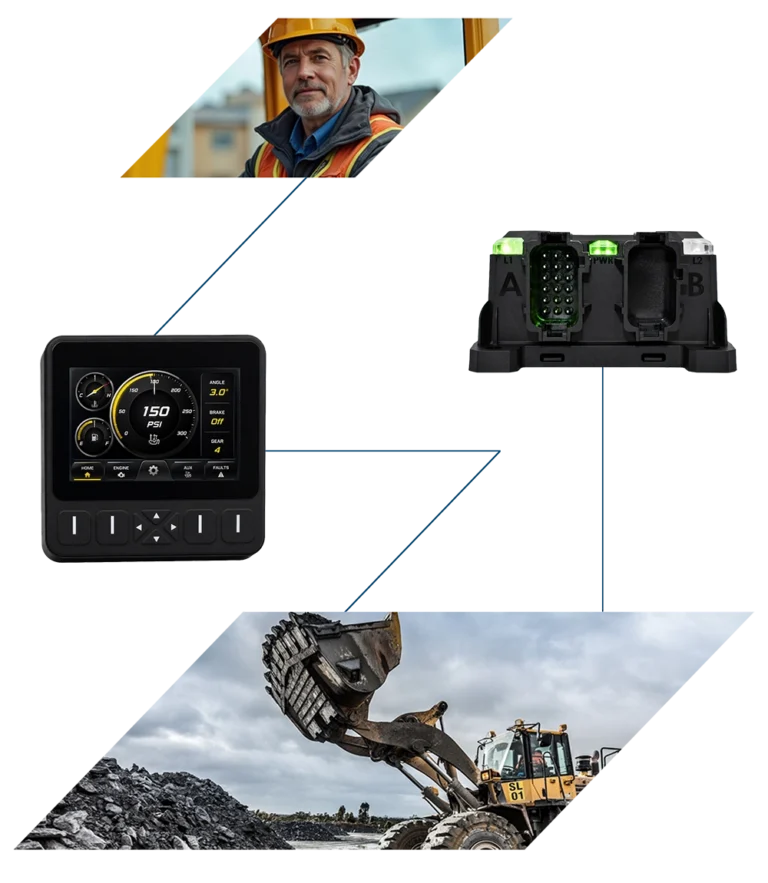
HED helps compact equipment OEMs simplify controls architecture by connecting machine functions, attachments, operator interfaces, diagnostics, and service visibility through a scalable CAN-based platform. Depending on the machine architecture, HED controllers and distributed I/O modules, displays, and CAN keypads can support that strategy as connected building blocks within a cleaner, more serviceable machine platform.
- Standardize attachment interfaces and control strategies across compact equipment families.
- Support configurable software profiles for attachments, operating modes, machine-state logic, and interlocks.
- Create a common controls backbone using controllers and distributed I/O, displays, CAN keypads, sensors, and operator interfaces.
- Reduce wiring complexity by supporting CAN-based communication and moving control closer to machine functions.
- Improve diagnostics, fault reporting, subsystem monitoring, and machine-state visibility through connected controls and operator displays.
- Support configurable operator input strategies with CAN keypads for attachments, modes, service functions, and machine controls.
- Help technicians isolate faults faster while supporting modular service architecture and future platform growth.
Proven value across Compact Equipment
Many OEMs share substantial functionality between families. HED enables reusable control architectures that support platform-specific features through software configuration.
A common architecture can support skid steers, compact track loaders, compact wheel loaders, compact backhoes, mini excavators, and compact telehandlers with machine-specific functionality built at the application layer.
HED can help OEMs implement a platform-based controls strategy that promotes standardization and reuse across machines supporting cleaner, smarter builds.
Skid Steers & Compact Loaders
- Support attachment ecosystems including augers, trenchers, cold planers, forestry mulchers, grapples, snow equipment, sweepers, and brush cutters.
- Support ride control, steering systems, boom functions, diagnostics, and operator interfaces.
- Improve diagnostics and fault isolation across drive functions, auxiliary hydraulics, displays, controls, and attachment systems in harsh operating environments.
Mini Excavators & Compact Backhoes
- Support breakers, grapples, compactors, augers, tilt attachments, and multiple auxiliary hydraulic packages while simplifying attachment selection, hydraulic modes, and operator feedback.
- Coordinate loader functions, backhoe functions, displays, auxiliary hydraulics, and diagnostics through a common controls platform.
Compact Telehandlers
- Coordinate forks, buckets, work platforms, grapples, and boom-mounted attachments while managing machine-state conditions and operator awareness.
- Provide visibility into boom control systems, operator interfaces, attachment functionality, and machine operating conditions.
Why OEMs Are Moving Toward Platform Architectures
The challenge facing engineering organizations is no longer simply adding another feature. The challenge is adding more capability without allowing engineering complexity to grow at the same rate.
- A scalable controls platform from HED helps compact construction equipment OEMs:
- Support larger attachment ecosystems
- Reduce electrical variants
- Accelerate validation across machine families
- Simplify manufacturing configurations
- Improve field serviceability
- Enable connected-machine initiatives
- Extend platform life without repeated redesign

Related Compact Construction Equipment Topics
For OEM teams evaluating equipment control architecture, these supporting pages take a deeper look at common engineering challenges behind hydraulic coordination, rugged reliability, platform scalability, and serviceability.
Ready to Simplify Your Compact Construction Platform?
Let’s discuss how HED can help reduce complexity, improve diagnostics, and support scalable machine architectures across your compact equipment portfolio.