
Improve Uptime by Designing Diagnostics Into the Controls Architecture
Many machine downtime events are not caused by a single failed component. They are the result of limited diagnostics, difficult fault isolation, and increasing electrical complexity.
What OEMs Need to Solve
- Wiring-related issues can require significant troubleshooting effort when technicians must isolate faults across harnesses, connectors, sensors, attachments, control modules, and machine-state conditions.

- Limited machine-state visibility can increase dealer diagnostic time because technicians may not know whether a fault is caused by wiring, software logic, an operator command, a sensor input, or a subsystem condition.
- Function- and subsystem-related issues become harder to isolate when hydraulic controls, attachments, operator inputs, sensors, and diagnostic feedback are not integrated into the broader machine architecture.
- Faster fault isolation helps dealers reduce troubleshooting time, return machines to work sooner, and protect customer confidence in the platform.
Why It Matters
The faster technicians identify the problem, the faster the machine returns to productive work. See our Diagnostic Path Mapper below to help identify delays.
HED’s Approach
HED helps construction equipment OEMs improve uptime by designing diagnostics and serviceability into the controls architecture from the start. CAN-based communication, distributed intelligence, machine-state visibility, and fault reporting can help technicians distinguish among wiring, software, sensor, communication, and subsystem conditions.
- Provide clearer fault information through displays, diagnostics, and control modules.
- Improve visibility into machine-state logic, attachment circuits, and subsystem behavior.
- Reduce service complexity by simplifying wiring and architecture.
- Help dealers and technicians isolate faults faster and return machines to work sooner.
Help Technicians Isolate Faults Faster
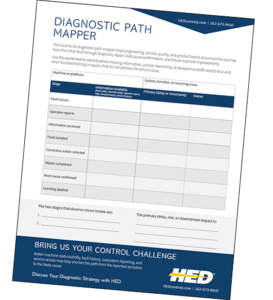 Finding the source of a machine fault may require information from the operator, service technician, wiring and connectors, sensors, control modules, communication networks, software, and machine-state logic.
The Diagnostic Path Mapper helps engineering, service, quality, and product teams document the journey from the initial fault through diagnosis, repair, root-cause confirmation, and future machine improvements. Use it to identify where important information is unavailable, ownership is unclear, handoffs create delays, or technicians must rely on trial and error.
Download now: Map Your Diagnostic Path
Whether you’re designing a new platform or evolving an existing one, a system-level review can help identify opportunities for smarter machine diagnostics. Request a System Architecture Review