
About the Customer
For more than four decades, this U.S.-based emergency vehicle manufacturer has built its reputation on quality craftsmanship, responsive customer service, and highly customized ambulance solutions. Because every vehicle serves a unique customer need, flexibility and reliability are essential to both the company’s manufacturing operations and the first responders who depend on its vehicles every day.
As customer requirements continued to evolve, the manufacturer recognized that the electrical architecture supporting its vehicle platforms needed to evolve as well.
The Challenge: A Control System That Was Limiting Growth
Customization is a competitive advantage in the ambulance industry. However, it can also create significant engineering and production challenges when the underlying electrical architecture was not designed to scale.
The manufacturer’s existing control system relied on a centralized architecture that routed nearly all vehicle inputs and outputs through a single control module. Over time, that approach began creating several operational challenges.
Large wire harnesses had to be routed through the vehicle to reach a central location, increasing installation complexity and creating additional opportunities for assembly errors and warranty issues. As vehicle options expanded, those harnesses continued to grow, making packaging and serviceability more difficult.

The OEM also faced limitations from a proprietary software environment that made it difficult to respond quickly to customer-specific requirements. Engineering changes often required outside support, reducing flexibility and slowing the ability to implement requested vehicle variations.
On top of that, the centralized architecture introduced a concentration of risk. If the primary controller experienced an issue, vehicle functionality could be significantly impacted. The manufacturer needed a more scalable and resilient approach that would support future vehicle development without increasing complexity.
The challenge was no longer simply controlling vehicle functions—it was creating a platform capable of supporting future growth, customization, and long-term reliability.
The Solution: A Distributed Architecture Built for Flexibility
HED partnered with the OEM to redesign the vehicle control system around a distributed, zonal architecture.
Rather than concentrating all functionality within a single control module, intelligent control modules were strategically placed throughout the vehicle based on location and function. This distributed approach significantly reduced wiring complexity while improving system scalability and fault isolation.
HED integrated rugged control modules and displays designed specifically for demanding mobile equipment applications. The new architecture shortened wire runs, simplified harness routing, and created a cleaner, more serviceable vehicle design.
Beyond the hardware architecture, HED also addressed one of the manufacturer’s biggest operational constraints: configuration flexibility.
Through a production-friendly configuration process, the OEM gained the ability to manage vehicle features internally using standard spreadsheet-driven workflows. Features and options could be enabled or disabled without relying on proprietary programming tools or outside software resources.
Instead of simply replacing components, HED helped the manufacturer establish a configurable vehicle platform that could adapt to changing customer requirements while maintaining production efficiency.
The Results: Better Quality, Faster Builds, and a More Scalable Platform
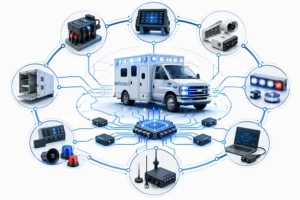
The transition to HED’s distributed control architecture delivered benefits across engineering, manufacturing, and service operations.
Improved Manufacturing Efficiency
Shorter wire runs and simplified harness routing reduced assembly complexity throughout the vehicle. Production teams could build vehicles more efficiently while reducing opportunities for wiring-related errors and rework.
Greater Flexibility for Custom Vehicle Configurations
The OEM gained far greater control over vehicle customization. Features and customer-specific options could be configured internally, improving responsiveness while reducing dependence on external software resources.
Reduced Quality and Warranty Risk
By eliminating many of the challenges associated with oversized centralized harnesses, the manufacturer reduced potential failure points and improved overall system robustness. The distributed architecture also minimized the impact of individual component failures.
Better Long-Term Serviceability
The zonal architecture simplified troubleshooting and maintenance by distributing functionality throughout the vehicle instead of concentrating it in a single location. This design helps technicians isolate and address issues more efficiently.
A Platform Built for Future Growth
Most importantly, the OEM established a scalable electrical architecture capable of supporting future vehicle programs, additional features, and evolving customer expectations without requiring a complete redesign of the control system.
Why This Matters to Other OEMs
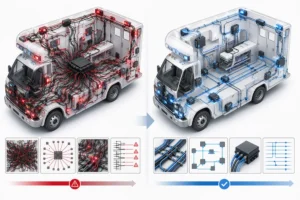
Many vehicle manufacturers face the same challenges this ambulance OEM encountered:
- Growing wire harness complexity
- Increasing assembly labor
- Expanding feature requirements
- Customer-driven customization demands
- Dependence on proprietary software platforms
- Rising quality and warranty concerns
As vehicles become more sophisticated, simply adding more wiring and more centralized controls often creates additional complexity rather than solving it.
By adopting a distributed control architecture, OEMs can reduce electrical complexity, simplify manufacturing, improve serviceability, and create a more scalable platform for future product development.
Partnering for the Next Generation of Vehicle Architecture
For this ambulance OEM, the move to zonal architecture was about more than upgrading electronic controls. It was an opportunity to replace a restrictive legacy system with a scalable platform designed for flexibility, quality, and long-term growth.
By combining distributed control hardware, configurable software tools, and deep application expertise, HED helped the manufacturer transform its electrical architecture into a competitive advantage—one that supports both production efficiency and the customization demands that define the modern emergency vehicle market.
Ready to Simplify Your Vehicle Architecture?
Talk with an HED application engineer about reducing complexity, improving flexibility, and building a platform that scales with your next generation of vehicles. Contact us to discuss your project