
The Challenge: Adding Intelligent Control to a Space- and Cost-Constrained Machine
A leading U.S.-based construction and agricultural equipment OEM needed a better way to bring intelligent machine control to a compact, stand-on landscaping machine.
The machine’s size created an immediate engineering challenge: there was limited room to add more electronics, more wiring, or more operator-interface hardware. At the same time, the OEM needed to improve operator control on a smaller, cost-sensitive platform.
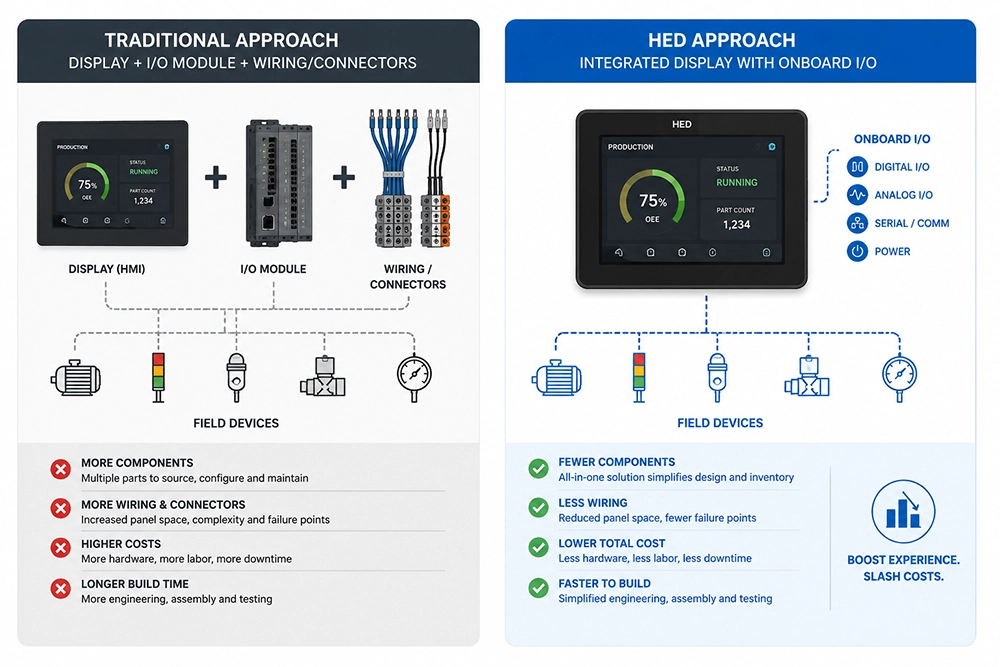
A traditional approach would have required a separate display and a separate input/output module. That meant more components to mount, more wiring to route, more connectors to manage, and more cost in a machine category where both space and price mattered.
For this OEM, the challenge was not simply finding a display. It was finding a control architecture that could support machine functionality, operator interaction, proportional hydraulic control, rugged outdoor use, and cost targets within the constraints of a compact equipment platform.
The Solution: Consolidating Display, Control, and I/O Into One Rugged Device
After meeting with the OEM’s engineering team at a trade show, HED proposed a single-display solution with integrated, high-density I/O capable of supporting machine inputs, outputs, and proportional hydraulic control.
Instead of separating the operator interface from the control hardware, HED helped consolidate key functions into one compact electronic control solution. The display provided the operator interface, onboard I/O, and machine-control capability needed for the application, reducing the need for a separate controller and simplifying the overall system layout.
This approach was especially important because the machine operated without a cab, leaving the electronics exposed to harsh outdoor conditions. HED’s solution was designed for that environment while still helping the OEM reduce the physical footprint of the control system.
HED also delivered hardware that was compatible with the OEM’s internal software development ecosystem, helping the engineering team transition without abandoning the tools and workflows already in place.
The Result: Lower Complexity, Fewer Failure Points, and a Better Operator Experience
By using one integrated display instead of a separate display and I/O module, the OEM reduced component count, saved valuable space, simplified the wire harness, and reduced the number of connectors in the system.
Because connectors are a common failure point and can add cost, this consolidation supported both near-term cost reduction and long-term reliability.
The single-component approach also helped lower total system cost while allowing the OEM to deliver the intelligent control functionality it wanted on a smaller, more cost-sensitive machine.
Just as important, the solution improved the operator experience. The unified system created a common look and feel across controls, added a richer feature set to the machine, and reduced the number of devices requiring software maintenance.
For the OEM, the outcome was more than a display upgrade. It was a cleaner control architecture that helped make intelligent machine control practical on compact equipment — reducing complexity without giving up functionality, ruggedness, or operator usability.
Why It Matters for Other OEMs
Many compact equipment platforms face the same tradeoff: operators expect smarter, more intuitive controls, but engineering teams still have to manage cost, packaging space, wiring complexity, serviceability, and long-term reliability.
HED helps OEMs rethink that tradeoff at the system level. By combining operator interface, I/O, control logic, and rugged hardware into the right architecture, OEMs can simplify integration, reduce component count, improve reliability, and create a stronger foundation for future machine functionality.
For compact construction equipment, the question is not just: What display should we use?
It is: How much machine control can we simplify by choosing the right integrated architecture from the start?
Ready to Simplify Your Compact Equipment Control System?
If you’re looking for a smarter way to add control functionality to a compact machine platform, HED can help you evaluate where integrated display I/O, CAN-based communication, and system-level architecture can reduce complexity without limiting capability. Contact us and let’s simplify your control system.