
Construction Equipment control systems
Electronic Control Systems
Design and integrate machine control, operator interface, I/O, power distribution and diagnostics within one scalable electronic architecture.
HED helps construction equipment OEMs reduce system complexity, improve reliability and create a consistent control approach across machine models and feature packages.
Construction Applications
Construction equipment must perform through shock, vibration, moisture, dust, temperature extremes and demanding duty cycles. At the same time, OEMs are managing more machine functions, electronic subsystems, attachments and model variations.
HED brings operator controls, machine logic, power distribution and communication together within a coordinated system designed around the application.
- Our system-level approach helps OEMs:
- Reduce wiring and integration complexity
- Coordinate hydraulic and electrical functions
- Standardize controls across machine families
- Improve operator-interface consistency
- Expand diagnostics and service visibility
- Support new features and machine variants
- Move more efficiently from prototype to production
Explore Construction Equipment Type
Select your equipment type to see how HED electronic control systems support specific machine applications.

Coordinate drivetrain, hydraulic, attachment and operator-interface functions across excavators, bulldozers, wheel loaders, motor graders and backhoe loaders.

Support attachment-driven machines with flexible controls for auxiliary hydraulics, operator configurations and machine options.
Applications include compact track loaders, skid steer loaders, compact wheel loaders, mini excavators and compact telehandlers.

Coordinate lift functions, operator controls, machine status and safety interlocks across cranes, telehandlers and mobile lifting equipment.

Integrate machine movement, material delivery, leveling, paving, compaction and operator feedback across concrete and asphalt equipment.
Applications include Slipform Pavers, Road Sweepers, Concrete Curb Machines and Mixers, Asphalt Graders, Pavers, and Rollers.

Control high-load hydraulic functions, rugged attachments and operator interfaces for equipment operating in rough terrain and demanding conditions.
Applications include Feller Bunchers, Harvesters, Stump Grinders, and Mulchers.
When OEMs Typically Reevaluate Their Control Architecture
HED helps OEMs evaluate requirements as part of the complete machine system rather than as isolated component decisions. Construction OEMs often engage HED when:
- Existing controls cannot support additional machine functions or I/O.
- Machine variants are creating too many harnesses, controllers or software configurations.
- New attachments must be added without redesigning the complete system.
- Relay-based or fragmented controls are increasing wiring complexity.
- A controller, display or electrical component is approaching end of life.
- Operators need a more consistent interface across machine models.
- Existing diagnostics do not provide enough information to resolve faults efficiently.
- The architecture must support future telematics, automation or remote vehicle programming.
- A prototype system needs to become a scalable, production-ready platform.
A Complete Machine Control Architecture
Modern construction equipment depends on more than individual components. Operator inputs, machine logic, power delivery, equipment functions and network communication all need to work together reliably in demanding environments.
HED designs electronic control systems to connect the full platform architecture—helping OEM engineering teams reduce complexity, streamline integration, and create a consistent, coordinated electronic control approach across vehicle and equipment models.
Operator Input
Rugged displays, keypads and operator controls provide access to machine functions, settings, warnings, cameras and diagnostics. Consistent layouts, menus and keypad behavior across machine models reduce operator retraining and give service teams a familiar interface.
Machine Control
Electronic control modules process operator commands, sensor data and application logic to control hydraulic, electrical and auxiliary functions. Distributed I/O can place control closer to machine functions, reducing long harness runs and supporting modular configurations.
Power Distribution
Protected power distribution manages electrical loads while reducing reliance on conventional relays, fuses and complex point-to-point wiring.
Machine Function
The architecture connects controls to hydraulics, attachments, sensors, drivetrain interfaces, lighting, auxiliary equipment and safety interlocks.
CAN/J1939 Network
A coordinated network allows displays, controllers, keypads and machine subsystems to share information across the platform.
Scalable Across Machine Platforms
A scalable architecture creates a common foundation that can be adapted across machine sizes, operator configurations and feature packages.
HED helps OEMs determine what should be standardized across the platform and what should remain configurable for each machine.
This approach can help teams:
- Reuse proven control logic
- Standardize operator-interface behavior
- Reduce unnecessary system variations
- Add options without redesigning the architecture
- Maintain common diagnostic and service practices
- Expand the system as machine technology evolves
The goal is not to make every machine identical. It is to create a repeatable architecture that accommodates meaningful differences without introducing unnecessary complexity.

Products That Support the Complete System
HED brings together electronic control modules, distributed I/O, power distribution, displays, keypads and application software within one coordinated machine architecture.
Process sensor inputs, application logic and output commands for hydraulic, electrical and auxiliary machine function.
Place inputs and outputs closer to machine functions to simplify harnessing and accommodate modular configurations.
Protect and manage electrical loads while improving diagnostic visibility across the machine.
Bring machine status, settings, warnings, cameras and diagnostics into a rugged operator interface.
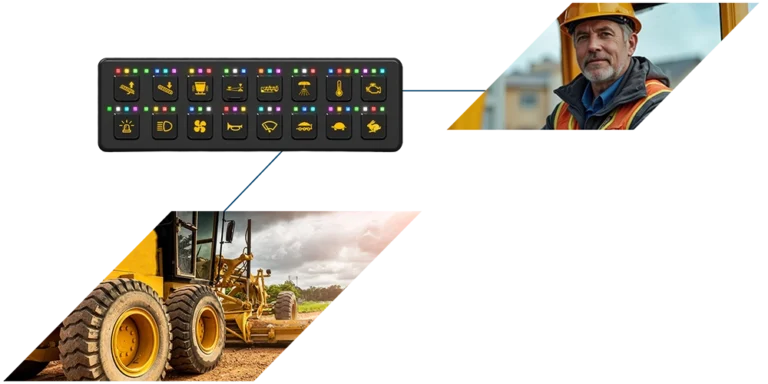
Provide configurable, tactile control for lighting, auxiliary hydraulics, attachments and operating modes.
Coordinate machine logic, CAN communication, diagnostics and operator-interface behavior across the complete system.
From Prototype Through Production
HED supports OEMs from architecture, product selection and software development through prototype integration, validation planning and launch—with ongoing support for system updates, new variants, component lifecycle planning and future connectivity needs.
VALIDATION AND TESTING
A rugged component is only one part of a reliable machine. The complete control system must perform within the electrical, environmental and operational conditions of the application.
HED can support:
LIFECYCLE SUPPORT
Construction equipment platforms can remain in production for years while new models, attachments and features continue to be introduced.
HED supports OEM teams through:
- System architecture and I/O review
- Network and communication planning
- Prototype integration
- Application software testing
- Operator-interface evaluation
- Bench and machine-level testing
- Environmental and electrical validation
- Fault handling and diagnostic verification
- Production implementation
- Troubleshooting and system updates
- Component lifecycle planning
- Expansion across new models
- Future connectivity and remote programming requirements
- This ongoing support helps OEMs maintain a consistent electronic foundation as their equipment platforms evolve.
Why Construction OEMs Choose HED
-
System-Level Expertise
HED considers the operator interface, control logic, I/O, power distribution, communication and machine functions as one coordinated architecture that integrates hardware and software. -
Application-Driven Design
We begin with how the machine needs to operate, not with a predetermined product list. -
Scalable Platform Thinking
Our architectures can support multiple models, feature packages and attachment configurations while preserving common elements. -
Support from prototype through production
We work with OEM teams from initial design and validation through production and future platform updates.

Plan Your Construction Equipment Control System
Developing a new machine? Modernizing a legacy control system? Standardizing controls across a machine family?
Share your preliminary I/O list, electrical schematic, machine functions, planned variants or project timeline. HED can help identify an appropriate approach to machine control, power distribution, operator interface and system integration.