
Forestry Equipment
Control Systems
Smarter Controls for Forestry Equipment OEMs
Forestry equipment operates where reliability is not optional. Machines work in remote, high-shock, debris-heavy environments where downtime can stop production, strand equipment far from service support, and drive costly troubleshooting.
HED helps forestry OEMs build rugged, scalable CAN-based control architectures that support harsh-environment electronics, remote diagnostics, coordinated hydraulic attachments, and automation-ready machine platforms.
Whether you build feller bunchers, skidders, forwarders, forestry harvesters, or knuckleboom loaders, HED can help reduce electrical complexity while improving machine uptime, service visibility, attachment flexibility, and readiness for future control-system growth.
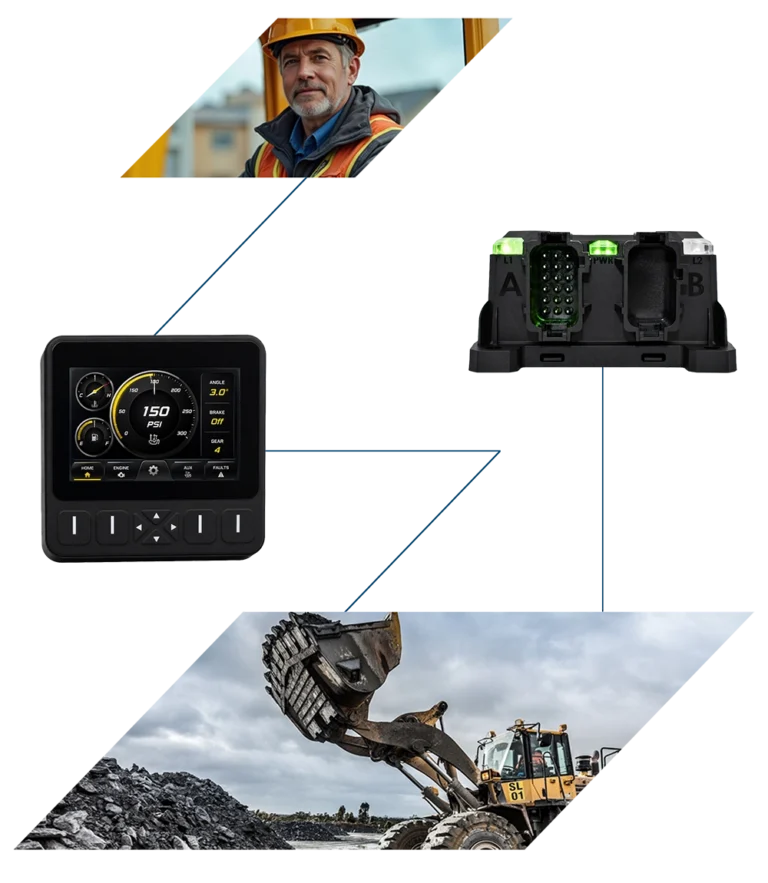
Four Controls Challenges Facing Forestry Equipment OEMs
We understand that forestry OEM engineering teams are not just adding controls. You are trying to coordinate hydraulics, attachments, operator input, diagnostics, machine-state logic, and rugged field performance across equipment that works in some of the toughest mobile environments.
HED helps engineering teams by providing full-system design support, reducing control-system complexity with rugged, scalable electronic architectures.
- HED helps you address four forestry-specific priorities:
- Designing harsh-environment electronics for extreme operating conditions
- Improving remote machine uptime with clearer diagnostics
- Coordinating hydraulic attachments and machine functions
- Preparing platforms for automation, smart attachments, and future feature growth
Forestry electronics must survive more than normal mobile-machine duty cycles. Shock, vibration, mud, water, dust, debris, branch strikes, temperature swings, and long operating shifts can expose every weakness in the electrical architecture.
For OEM engineers, reliability starts with a system-level design that protects control modules, displays, keypads, sensors, connectors, harness routing, and distributed I/O from harsh forestry conditions.
Common Engineering Challenges
- Protect electronics from shock, vibration, moisture, dust, temperature extremes, and forestry debris
- Reduce exposed harness length through booms, frames, engine compartments, and moving structures
- Place distributed control closer to high-risk or high-function machine areas
- Improve packaging, service access, and diagnostic visibility in remote conditions
Risk to OEMs
- If electronics are not designed for the forestry environment from the beginning, OEMs may see more warranty claims, longer troubleshooting events, and reduced operator confidence in the machine platform.
Learn more about harsh-environment electronics for forestry equipment.
Forestry machines often work far from service bays, parts access, and dealer support. When a fault occurs in the woods, teams need to know what failed, where the issue is likely located, and what information a technician needs before traveling to the machine.
A diagnostic-ready CAN-based architecture can help operators, dealers, and service teams move from reactive troubleshooting to faster fault isolation and better service planning.
Common Engineering Challenges
- Improve fault visibility when machines are operating far from service support
- Monitor modules, sensors, inputs, outputs, hydraulic functions, communication faults, and machine-state conditions
- Give technicians clearer service information before they arrive on site
- Capture machine status, warnings, operating modes, and diagnostic data for service and product improvement
Risk to OEMs
- Poor diagnostics can turn small electrical, hydraulic, sensor, or communication issues into long field-service events, repeat troubleshooting, avoidable downtime, and higher warranty costs.
Forestry machines depend on hydraulic attachments that must work together with the base machine, operator commands, sensors, safety interlocks, and machine-state logic. A harvester head, saw, grapple, winch, crane, boom, or auxiliary tool cannot be treated as an isolated function.
As OEMs add more attachment options and configuration choices, coordinated hydraulic control helps reduce wiring complexity, improve control consistency, and simplify validation across machine variants.
Common Engineering Challenges
- Coordinate boom, head, saw, grapple, winch, crane, feed, measuring, and auxiliary attachment functions
- Integrate operator inputs, displays, keypads, joysticks, sensors, interlocks, valve outputs, and feedback signals
- Support attachment variants without multiplying harnesses, controller layouts, and validation effort
- Improve diagnostics across attachment circuits to isolate electrical, hydraulic, sensor, and communication issues faster
Risk to OEMs
- Without a coordinated control strategy, every new head package, hydraulic option, attachment type, or customer configuration can add wiring complexity, software variation, validation burden, and long-term service risk.
Learn more about coordinating forestry hydraulic attachments.
Forestry automation often begins with smarter attachments, additional sensors, operator assistance, telematics, configurable software, and machine functions that need to work together more intelligently.
OEMs need a control architecture that can adapt as machines, attachments, data requirements, and customer expectations evolve without requiring a full electrical-system redesign each time.
Common Engineering Challenges
- Prepare platforms for smart attachments, updated head options, sensor packages, and assisted-control features
- Support machine-state awareness across hydraulics, operator inputs, attachment status, diagnostics, and safety-related logic
- Create a common CAN-based foundation for telematics, remote diagnostics, configurable features, and future software updates
- Reduce redesign risk when adding new operator interfaces, control modes, attachment types, or customer-specific options
Risk to OEMs
- Without a future-ready foundation, sensors, smart attachments, telematics, and software-configurable features can require disruptive redesigns instead of controlled platform evolution.
See how future-ready controls support future forestry platforms.
HED helps forestry OEMs reduce control-system complexity with rugged, scalable electronic architectures that connect harsh-environment electronics, diagnostics, hydraulic attachment control, operator interfaces, telematics-ready data, and future feature growth through a cleaner CAN-based platform.
For engineering teams, the value is not just in the components. It is in how those technologies work together to simplify integration, improve service visibility, and create a more repeatable controls foundation across forestry equipment families.
- Protect control modules, distributed I/O, displays, CAN keypads, sensors, connectors, and harness routing in harsh forestry environments.
- Give operators and service teams clearer visibility into machine status, fault messages, warnings, operating modes, configuration data, and service information.
- Coordinate hydraulic outputs, work-tool logic, operator commands, sensors, diagnostics, and machine-state control across attachment options.
- Support smart attachments, telematics-ready data, configurable features, and automation-ready platform growth through a unified CAN-based foundation.
- Help OEMs create a more repeatable controls strategy for engineering, manufacturing, validation, service, and long-term platform planning.
Proven value across Forestry Equipment
Many forestry equipment families share similar control needs, even when each platform requires machine-specific functionality.
HED helps OEMs reuse a common controls architecture across forestry platforms while configuring application-specific features in software.
Feller Bunchers
- Coordinate boom, head, saw, accumulation, travel, operator inputs, diagnostics, and machine-state feedback in a rugged controls architecture.
- Support visibility into boom and head control, hydraulic outputs, operator interface, and machine feedback during continuous cutting cycles.
Forestry Harvesters
- Support coordinated boom functions, harvester heads, feed rollers, delimbing knives, measuring systems, saw control, operator displays, alerts, and diagnostics.
- Improve visibility into head control, feed functions, sensor feedback, operator commands, and machine-state conditions.
Knuckleboom Loaders
- Coordinate boom, swing, grapple, stabilizer-related logic, cab controls, lighting, alarms, service feedback, and diagnostics.
- Simplify wiring and improve fault visibility across boom-mounted and body-mounted systems.
Skidders
- Support grapple or winch control, drivetrain feedback, operator interface, lighting, alerts, machine status, and diagnostics.
- Improve fault isolation across work-tool control, lighting, inputs, outputs, operator controls, and machine-status systems.
Forwarders
- Coordinate crane functions, grapple control, load-area lighting, operator feedback, service diagnostics, and machine-status visibility.
- Reduce wiring complexity across long machine structures while improving service visibility.
Smarter Control
As forestry equipment becomes more capable, OEMs need control architectures that can withstand harsh environments, support remote diagnostics, coordinate hydraulic attachments, and prepare platforms for smarter machine functions without adding unnecessary wiring, custom logic, or one-off integration.
A scalable controls platform helps OEMs:
- Design electronics for shock, vibration, moisture, debris, temperature extremes, and long-duty-cycle forestry operation
- Improve remote uptime and service planning with clearer diagnostic visibility
- Coordinate hydraulic attachments, work-tool logic, operator interfaces, sensors, and machine-state control
- Prepare platforms for smart attachments, telematics, automation-ready features, and software-configurable growth
The goal is a machine architecture that can handle forestry complexity today while giving OEMs a cleaner foundation for tomorrow’s diagnostics, attachments, automation, and platform growth.

Related Forestry Control Topics
For OEM teams evaluating forestry control architecture, these supporting pages take a deeper look at the four priorities behind rugged machine performance, remote uptime, hydraulic attachment coordination, and future-ready platform growth.
Ready to Simplify Your Forestry Equipment Platform?
Let’s discuss how HED can help you design rugged, diagnostic-ready, future-ready CAN-based control architectures for your next forestry equipment platform.