
Remote Logging Operations Need Faster Fault Visibility
Forestry machines often work far from service bays, dealer support, and easy parts access. When a machine stops in the woods, the first challenge is not always the repair itself. It is knowing what failed, where the fault occurred, and what the technician needs before traveling to the site.
Remote diagnostics help OEMs, dealers, and fleet teams move from reactive troubleshooting to faster fault isolation, better service planning, and improved machine uptime across logging operations.
What OEMs Need to Solve
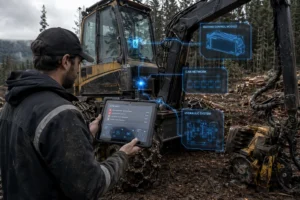 For remote forestry operations, uptime depends on clear machine data, actionable fault information, and a control architecture that can help separate electrical, hydraulic, sensor, communication, and operator-interface issues.
- Give operators and service teams clearer fault messages before a small issue becomes a long downtime event.
- Use CAN-based subsystem monitoring to identify module, input, output, sensor, communication, and machine-state faults more quickly.
- Support remote service planning by helping technicians understand likely root causes before arriving on site.
- Capture machine status, warnings, operating modes, and diagnostic data that can support dealer service and OEM product improvement.
- Reduce repeat troubleshooting caused by intermittent vibration, moisture, debris, or wiring-related faults.
Why It Matters
In logging, downtime can interrupt cutting, extraction, loading, and hauling. Better diagnostics help reduce uncertainty by giving teams a clearer path from fault detection to field repair. The faster the issue is understood, the faster the machine can return to productive work.
HED’s Approach
HED helps OEMs build diagnostic-ready control architectures that connect controllers, displays, CAN keypads, distributed I/O, sensors, and machine logic through a unified CAN-based platform. This foundation can improve fault visibility, support connected-machine initiatives, and help forestry equipment become easier to diagnose in remote operating conditions.
Help Technicians Isolate Faults Faster
Whether you’re designing a new platform or evolving an existing one, a system-level review can help identify opportunities for smarter machine diagnostics. Request a System Architecture Review