
Forestry Attachments Need Coordinated Control, Not Isolated Functions
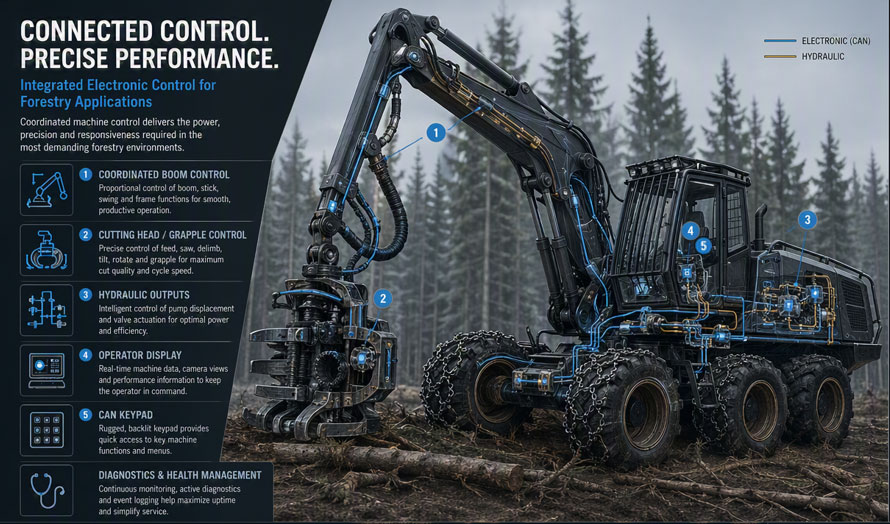
Forestry machines depend on hydraulic attachments that must work together with the base machine, operator commands, sensors, safety interlocks, and machine-state logic. A harvester head, saw, grapple, winch, crane, boom, or auxiliary tool cannot be treated as a standalone function if the operator experience and machine performance need to stay consistent.
As OEMs add more attachment options and configuration choices, coordinated hydraulic control becomes essential for reducing wiring complexity, improving control consistency, and simplifying validation across machine variants.
What OEMs Need to Solve
The core engineering challenge is coordinating multiple hydraulic functions without creating a new wiring and software problem for every attachment, head package, or customer configuration.
- Coordinate boom, head, saw, grapple, winch, crane, feed, measuring, and auxiliary attachment functions with machine-state logic.
- Integrate operator inputs, displays, keypads, joysticks, sensors, interlocks, valve outputs, and feedback signals into one control strategy.
- Support attachment variants without multiplying harnesses, controller layouts, and validation effort.
- Use software configuration to adapt control behavior across machine models, tool options, and customer requirements.
- Improve diagnostics across attachment circuits so service teams can isolate electrical, hydraulic, sensor, and communication issues faster.
Why It Matters
Attachment variety can become an engineering burden if every option requires a different control approach. A coordinated CAN-based architecture helps OEMs manage complex hydraulic functions while keeping the platform more repeatable for engineering, manufacturing, service, and future feature development.
HED’s Approach
HED helps OEMs coordinate hydraulic attachments with controllers, distributed I/O, displays, keypads, sensors, and CAN-based communication. This approach supports more consistent control logic across attachment options while reducing point-to-point wiring and improving visibility into attachment-related faults.
Explore Forestry Equipment Control Systems