
Road Building Equipment
Control Solutions
Smarter Controls for Road Building Equipment
Simplify electrical architecture, improve diagnostics, and support more capable machines across your road building equipment portfolio.
Explore HED’s road building equipment solutions below and talk with us to learn how HED can help simplify your machine controls.
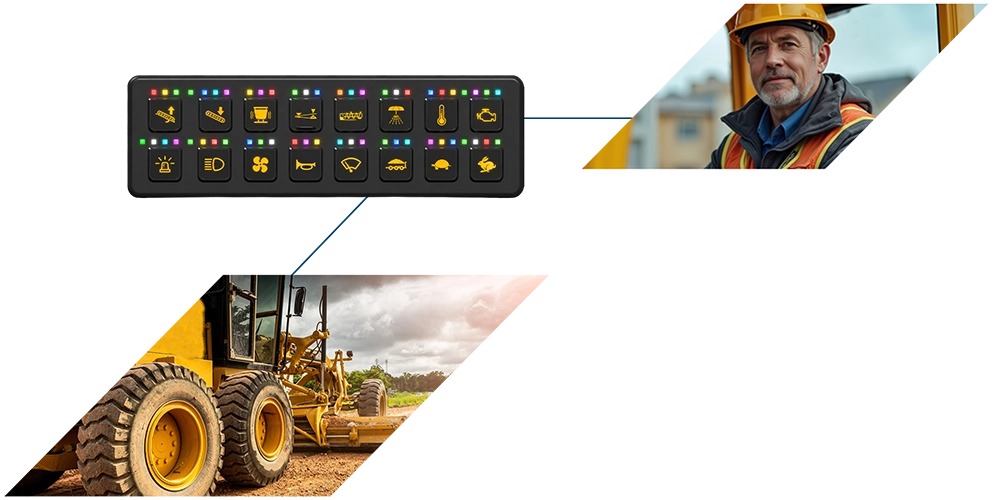
Four Controls Challenges Facing OEMs Building Road Equipment
Road building equipment OEMs need more than individual components. They need a controls platform that helps reduce wiring complexity, coordinate machine functions, and support long-term product growth.
HED helps OEMs move from hardwired complexity to CAN-based control systems designed for performance, serviceability, and scalability.
- HED helps OEMs address four core challenges:
- Precision Machine Control
- Harsh-Environment Durability
- Consistent Paving Performance
- Maximizing Contractor Productivity
Help road building machines respond more predictably by coordinating operator inputs, hydraulic work functions, machine-state logic, diagnostics, and feedback in one integrated controls architecture.
Common Engineering Challenges
- Coordinate functions such as screed control, blade positioning, vibration, spray systems, lighting, and operator inputs.
- Support precise sequencing, interlocks, and more repeatable machine behavior.
- Improve operator confidence with clearer status feedback, alerts, and diagnostics.
Design road building equipment controls to remain reliable through constant vibration, repeated shock, dust, moisture, washdown, chemical exposure, and wide temperature swings.
Common Engineering Challenges
- Select sealed components with ingress-protection ratings appropriate for dust, water exposure, temporary immersion, and high-pressure washdown.
- Validate controllers, displays, keypads, connectors, and mounting strategies for sustained vibration and repeated shock loads.
- Confirm operating-temperature range, thermal cycling, chemical resistance, and environmental testing against the machine’s real duty cycle.
Read: Designing Durable Electronics for Road Building Equipment
Support more repeatable paving results by keeping material flow, screed coordination, compaction support, machine-state feedback, and diagnostics aligned with the work being done.
Common Engineering Challenges
- Coordinate conveyors, augers, screed controls, vibration, spray systems, lighting, and operator feedback.
- Support more predictable machine behavior through consistent control logic and calibrated inputs.
- Create a scalable foundation for connected diagnostics, telematics, and future paving performance features.
Read: Consistent Paving Performance Starts with Smarter Controls
Help contractors keep crews moving with road building equipment controls designed for uptime, faster troubleshooting, clearer machine feedback, and more dependable jobsite output.
Common Engineering Challenges
- Reduce avoidable downtime by limiting wiring-related failure points and improving fault isolation.
- Help operators and technicians understand issues faster with displays, alerts, diagnostics, and machine-state feedback.
- Keep critical jobsite functions available across demanding paving and road maintenance schedules.
Read: Road Building Equipment Controls That Maximize Contractor Productivity
HED helps road building equipment OEMs simplify control-system complexity with rugged, scalable CAN-based architectures that coordinate machine functions, operator interfaces, diagnostics, distributed I/O, and future feature growth across pavers, graders, rollers, sweepers, mixers, and related road surface equipment.
For engineering teams, the value is how these technologies work together to improve precision machine control, withstand harsh road building environments, support more consistent paving performance, and help contractors keep machines productive on demanding jobsites.
- Coordinate road building functions such as screed control, blade positioning, conveyors, augers, vibration, spray systems, lighting, sensors, diagnostics, and machine-state logic through controllers and distributed I/O placed closer to key functions.
- Give operators and technicians clearer visibility into machine status, faults, warnings, work modes, configuration data, and service information through rugged displays designed for harsh construction environments.
- Simplify control of auxiliary functions, operating modes, material-handling systems, lighting, service functions, and operator commands with CAN keypads that reduce wiring complexity and improve interface consistency.
- Connect machine inputs, outputs, operator interfaces, diagnostics, telematics-ready data, and future feature expansion through a unified CAN-based platform.
- Help OEMs create a repeatable controls strategy for engineering, manufacturing, validation, service, fleet standardization, and long-term road building platform planning.
Proven value across key road building equipment
Road building machines such as Pavers, Graders, Rollers, Mixers and Sweepers require coordinated control across work functions, operator inputs, and machine-state conditions in harsh environments.
HED helps OEMs unify those systems in a scalable architecture that supports cleaner builds and smarter function coordination.
Pavers
Coordinate hopper, conveyor, auger, screed, lighting, and operator feedback in one integrated controls architecture.
Graders
Support blade and implement control, steering and articulation-related logic, travel and work modes, and clear machine-status visibility.
Rollers
Manage vibration, water spray, lighting, alerts, and machine-state logic with better diagnostics and fewer wiring-related failure points.
Mixers
Coordinate drum rotation, chute positioning, water systems, load status, lighting, and operator feedback with a scalable controls architecture built for demanding concrete and material delivery applications.
Sweepers
Integrate broom control, vacuum systems, water spray, debris handling, lighting, alerts, and machine-status feedback to support efficient municipal, construction, and road maintenance operation.
Why OEMs Choose HED
HED combines rugged controllers, displays, keypads, modular I/O, and application support to help OEMs build a more integrated machine architecture.
The result is a controls platform that helps reduce engineering burden, support repeatable builds, and improve lifetime serviceability.
- Rugged controllers, displays, and keypads designed for demanding mobile environments
- Full-system design support to streamline procurement and integration
- Long-term product and application support for extended equipment lifecycles
HED helps OEMs reduce harness complexity, standardize architecture, and support advanced machine functions without expanding internal controls resources.
- Reduce engineering burden across paver, grader, and roller programs
- Support faster, more repeatable machine builds across model variants
- Create a more scalable platform for future feature additions and software-based changes
Modern paving and road surface equipment needs a control architecture that can coordinate key machine functions, operator inputs, and diagnostics without repeated redesign.
- Support integrated control across work functions and machine states
- Improve operator visibility through built-in diagnostics and status feedback
A better controls architecture does more than simplify design. It can reduce failure points, speed fault isolation, and keep machines available for productive work.
- Reduce troubleshooting and service time in the field
- Improve serviceability through better diagnostics and modular function control
- Lower lifecycle complexity across the platform
Build Your next machine platform with confidence
The next generation of road building equipment will require more than rugged hardware. OEMs need control systems that can support more machine intelligence, more flexible configurations, stronger diagnostics, and easier platform evolution.
HED helps OEMs build that foundation.
Whether you are developing pavers, graders, mixers, sweepers or rollers, HED can help simplify and scale the control system behind the machine. Contact us to find out how.

Related Road Building Equipment Topics
For OEM teams evaluating road building equipment control architecture, these supporting pages take a deeper look at common engineering challenges behind machine function, rugged reliability, platform scalability, and serviceability.
Ready to Simplify Your Next Road Building Platform?
Let’s talk about how HED can help reduce complexity, improve diagnostics, and support a smarter equipment platform.