
Utility & Municipal Vehicles Need More Than Basic Body Control
Utility and municipal vehicles do not operate one function at a time. Snow removal vehicles, refuse trucks, bucket trucks, sweeper trucks, and pumper trucks depend on coordinated interaction between operator commands, body outputs, hydraulic functions, work equipment, interlocks, power distribution, and diagnostic feedback.
As vehicle functions become more integrated, the electrical and control architecture behind those functions becomes more important.
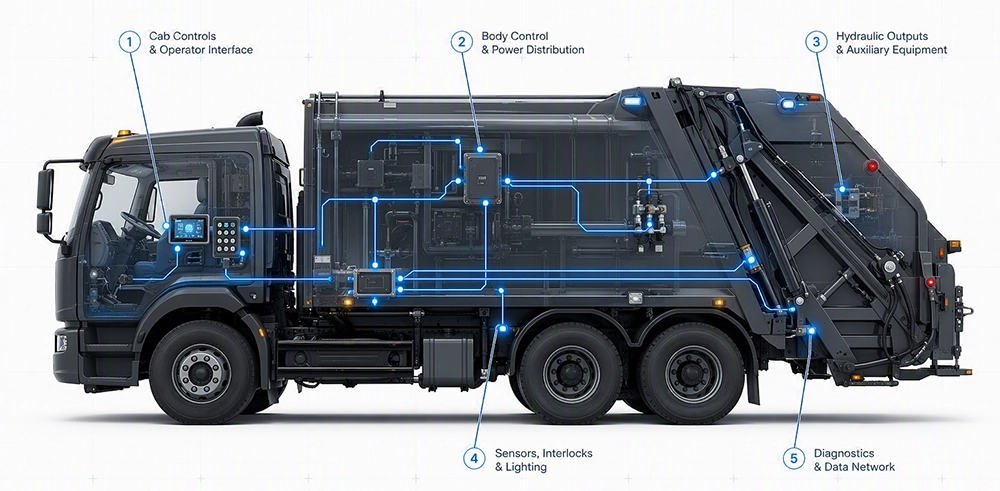
What OEMs Need to Solve
The most important engineering questions usually come down to how many functions must be coordinated, how much wiring the architecture creates, and how easily the system can be configured, validated, and serviced over time.
- Snow removal vehicles may need coordinated control across plows, wings, spreaders, brine systems, lighting, hydraulic outputs, and operator feedback.
- Refuse trucks may need coordinated control across compaction systems, lift mechanisms, body functions, alarms, interlocks, service diagnostics, and operator interfaces.
- Bucket trucks may need boom controls, platform controls, ground controls, outriggers, interlocks, alarms, lighting, and hydraulic function coordination.
- Sweeper trucks may need integrated control across brooms, vacuum systems, water spray, debris handling, lights, alarms, and machine feedback.
- Pumper trucks may need organized control across pumps, valves, tanks, lighting, operator panels, auxiliary outputs, and diagnostics.
- A shared CAN-based architecture can reduce duplicated wiring and make functionality easier to configure across vehicle variants.
Why It Matters
When every work function is handled as a separate integration problem, OEMs can end up with more wiring, more variants, and more service complexity than the platform can efficiently support. The controls challenge is not one function. It is coordinating many functions without multiplying engineering and service burden.
HED’s Approach
HED helps OEMs manage body-control complexity with CAN-based control architectures that connect controllers, distributed I/O, operator interfaces, sensors, power distribution, and diagnostics into a coordinated system. This gives engineering teams a more flexible way to manage hydraulic functions, lighting, auxiliary outputs, interlocks, work equipment, and operator feedback while reducing the need for excessive point-to-point wiring.
Key Takeaway
Body-control complexity grows quickly when every function is treated as a separate wiring problem. A smarter controls architecture helps OEMs coordinate more vehicle capability with less electrical complexity.