
When a machine goes down, finding the problem can sometimes take longer than fixing it.
A warning appears. A function stops responding. An intermittent fault shows up in the field but disappears in the shop. The technician knows something is wrong, but determining whether the issue is wiring, a sensor, an input, an output, communication, software logic, or another subsystem can require extensive troubleshooting.
As mobile equipment becomes more capable and control systems more interconnected, diagnostic visibility becomes increasingly important.
Better diagnostics give operators, technicians, and support teams clearer insight into what the machine is doing and where a problem may be occurring, creating a more direct path from fault to fix.
Why Troubleshooting Gets More Difficult as Machines Become More Complex
Modern mobile equipment may coordinate controllers, sensors, displays, operator inputs, hydraulic functions, distributed I/O, attachments, interlocks, and other subsystems. When those functions are not supported by clear diagnostic information, technicians may have to investigate multiple potential causes before identifying the actual problem.
Common challenges include:
- Limited visibility into machine and subsystem status
- Electrical faults hidden within wiring, connectors, and harnesses
- Intermittent problems caused by vibration, moisture, corrosion, or changing operating conditions
- Unclear relationships between operator commands, sensors, outputs, and machine logic
- Communication faults between devices or subsystems
- Difficulty reproducing field conditions in the service bay
The failure itself may not be difficult to repair. The challenge is determining what actually failed.
Good Diagnostics Answer More Than “What Failed?”
Useful diagnostics provide context around the fault, helping technicians understand what the machine was seeing and doing when the problem occurred.
Depending on the system, that can include visibility into:
- Input and output status
- Sensor conditions
- Controller communication
- Machine operating state
- Operator commands
- Interlock conditions
- Power status
- Active warnings and faults
If a machine function will not operate, better system visibility helps answer more useful questions:
- Did the operator command reach the system?
- Is the required sensor condition present?
- Are the necessary interlocks satisfied?
- Did the controller command the output?
- Is the affected device communicating?
Instead of troubleshooting every possible cause, technicians can focus their efforts where the problem is most likely occurring.
Design Diagnostics Into the Control Architecture
Diagnostics are most effective when they are considered as part of the control architecture rather than added after the machine has been developed.
A CAN-based control architecture can allow controllers, distributed I/O, displays, keypads, sensors, and other devices to share information across the machine, creating a foundation for monitoring system conditions and communicating useful diagnostic information.
Provide Clearer Fault Information
Help identify the affected device, input, output, sensor, communication path, or machine condition rather than simply indicating that something is wrong.
Improve Machine-State Visibility
Give technicians greater insight into whether a problem is related to a physical failure, control logic, an interlock, operator input, or another operating condition.
Reduce Unnecessary Troubleshooting
Use available system information to narrow the diagnostic path instead of beginning with every possible cause.
Support More Consistent Service
Provide technicians, dealers, and support teams with a more repeatable way to troubleshoot equipment across machines and configurations.
From Reactive Troubleshooting to Faster Fault Isolation
Diagnostic visibility changes how a technician approaches a machine problem. Instead of investigating every possible cause, fault and machine-state information can help narrow the troubleshooting path.
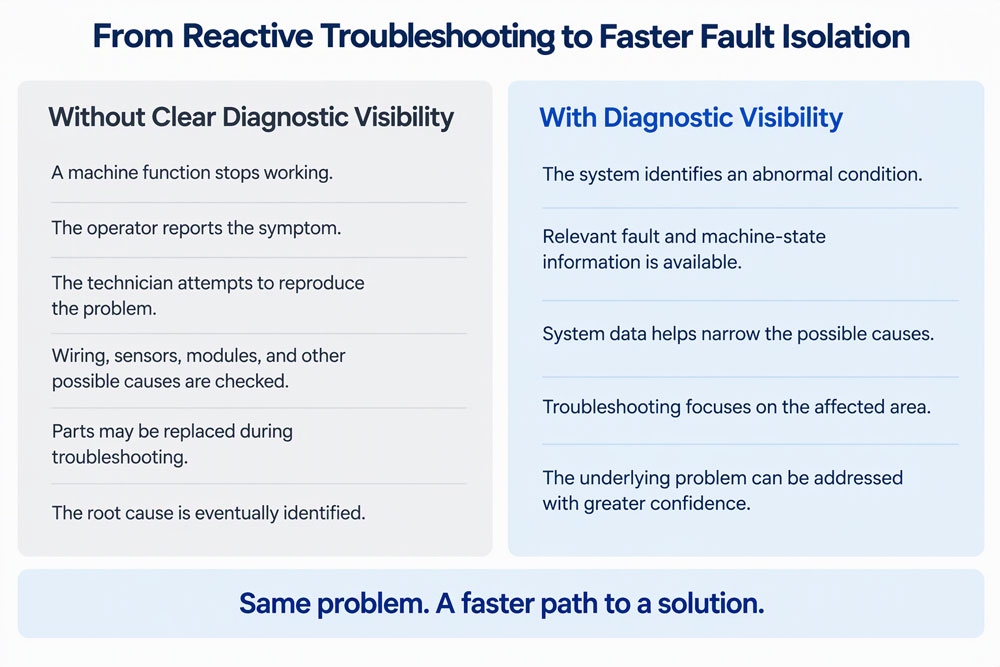
The goal isn’t simply to collect more data. It’s to provide actionable information that helps someone make a faster, better service decision.
Better Diagnostics Support Better Uptime
Diagnostic visibility benefits more than the technician making the repair.
- Operators receive clearer information about machine conditions and faults.
- Technicians can narrow problems faster and reduce trial-and-error troubleshooting.
- Dealers and fleet teams have better information for service planning and support.
- OEM support teams can work from meaningful machine information when helping customers diagnose problems.
- Engineering teams can gain greater insight into field issues and use those findings to improve future designs.
The impact ultimately comes back to uptime. Depending on the application, downtime can mean an interrupted job, delayed service, an unavailable fleet asset, a technician traveling to a remote machine without the right parts, or equipment sitting idle while the problem is diagnosed.
Reducing downtime therefore isn’t only about building reliable equipment. It’s also about building equipment that’s easier to understand when something does go wrong.
Build Serviceability Into the Machine from the Start
HED helps OEMs develop control architectures that connect controllers, displays, keypads, distributed I/O, sensors, operator interfaces, and machine functions through a coordinated control platform.
By considering diagnostics alongside control logic and system architecture, OEMs can create machines that provide clearer information when faults occur and give service teams a more direct path toward resolving them.
Better uptime starts with better visibility.
Help Technicians Get From Fault to Fix Faster
Whether you’re developing a new platform or improving an existing machine, HED can help identify opportunities to build better diagnostic visibility and serviceability into the control architecture.