
Build Controls That Can Grow as Airport Equipment Adds New Capabilities
Airport ground support equipment is becoming more connected, more electrified, and more dependent on software-defined machine behavior, but each machine adds capability in a different way.
For OEMs, scalability is about building a controls foundation that can grow as a baggage loader adds smarter conveyor diagnostics, a cargo loader adds new deck-position logic, a catering truck adds more lift and stabilizer options, a de-icing vehicle adds fluid, boom, and telematics features, or a safety vehicle adds additional warning, power, and mission-support functions.
What OEMs Need to Solve
- Design control systems that can expand as machines add new functions such as conveyor monitoring, deck-position sensing, lift sequencing, boom controls, fluid-delivery data, warning systems, diagnostics, displays, and connected features
- Support future machine configurations, option packages, customer-specific controls, regional requirements, and application-specific feature sets without starting over electrically
- Reduce harness variation, controller changes, software rework, validation effort, and service documentation burden as equipment platforms add capabilities
- Prepare for telematics, remote diagnostics, electrification updates, data-driven service tools, configurable operator interfaces, and smarter machine behavior over time
- Avoid one-off engineering work every time a loader, truck, de-icer, or safety vehicle receives a new feature, option, diagnostic requirement, or customer-specific configuration
Why It Matters
As airport equipment evolves, the added complexity is usually specific to the machine: more conveyor data on loaders, more deck logic on cargo equipment, more stabilizer and lift sequencing on catering trucks, more boom and fluid-system intelligence on de-icing vehicles, or more auxiliary power and warning functionality on safety vehicles. If the controls foundation was not designed to grow, those additions can increase development time, validation effort, wiring complexity, and long-term service burden.
HED’s Approach
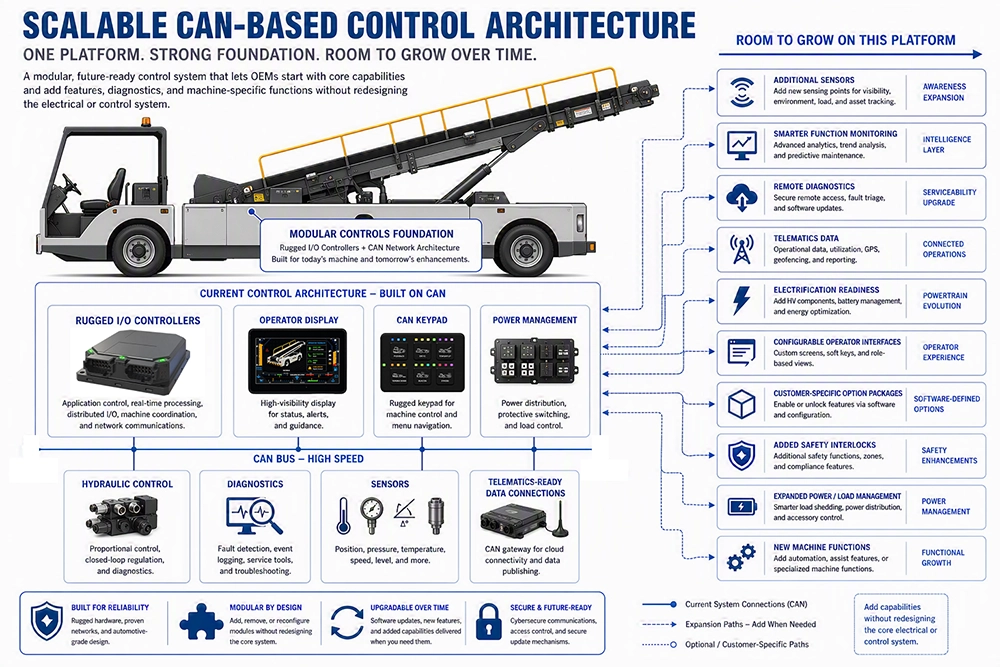
HED helps OEMs create scalable control platforms that can grow as airport equipment adds new capabilities, options, diagnostics, operator interfaces, telematics-ready data, and software-configurable features. A common CAN-based foundation can connect controllers, distributed I/O, displays, CAN keypads, sensors, power management, hydraulic control, and machine-state logic while still allowing application-specific behavior at the software and I/O level. This gives engineering teams a more flexible way to support future conveyor monitoring, deck-position logic, lift and stabilizer options, boom and fluid-system intelligence, warning-system expansion, remote diagnostics, and customer-specific configurations without redesigning the core electrical system each time.
Designing airport equipment that needs room to add future features, diagnostics, options, or connected capabilities?
Contact HED to start planning a scalable controls foundation.