
Build Vehicle Programs That Can Evolve Without Redesigning the Controls Architecture
Utility and municipal vehicle programs rarely stand still. Within an OEM’s own product family, engineering teams may need to support new body layouts, updated control panels, added diagnostics, new lighting packages, customer-specific options, connectivity needs, power-management changes, or future work-equipment features.
A hardwired or one-off control strategy can make those changes expensive. A scalable CAN-based architecture gives utility and municipal vehicle OEMs a stronger foundation for evolving a defined vehicle platform, model line, or product family over time.
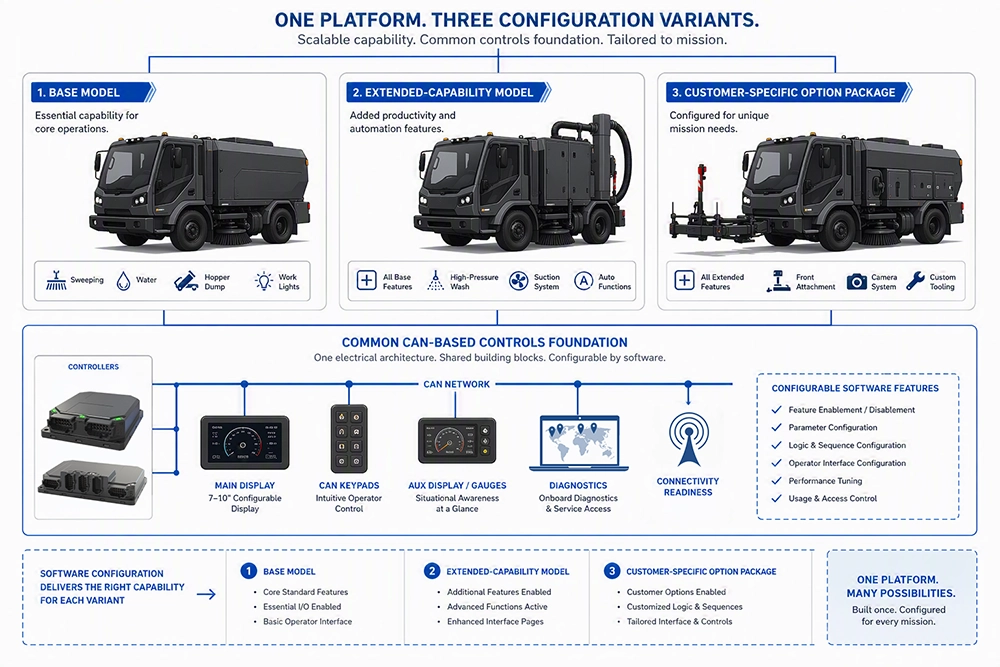
What OEMs Need to Solve
- A utility or municipal vehicle OEM may need flexibility across model-year updates, feature packages, regional requirements, customer options, and production variants within its own vehicle program.
- Related configurations within the same vehicle family may require different operator controls, body functions, hydraulic outputs, lighting packages, diagnostic screens, or safety interlocks.
- Engineering teams need a way to add or modify features without redesigning the full wiring architecture for every option package.
- Manufacturing teams benefit when common controllers, displays, keypads, I/O modules, and harness strategies can be reused across related builds.
- Service teams need consistent diagnostic logic and fault visibility across variants so technicians are not learning a completely different system for every configuration.
- Software-configurable controls can help OEMs adapt features while protecting the core electrical and control architecture.
- A common architecture within an OEM’s own municipal or utility vehicle family can improve reuse, simplify validation, and support long-term platform planning without suggesting one OEM builds every type of municipal vehicle.
Why It Matters
Future-ready utility and municipal vehicle programs are not just about adding more technology. They are about creating an architecture that can absorb new requirements within an OEM’s own vehicle platform or product family without forcing repeated redesign. A scalable control platform helps OEMs add capability while protecting the core architecture as that vehicle family evolves.
HED’s Approach
HED helps utility and municipal vehicle OEMs build scalable control platforms that can support new vehicle options, updated operator interfaces, expanded diagnostics, power-management requirements, connectivity readiness, and software-configurable features. A common controls foundation can make it easier to reuse architecture across related models, trims, and configurations within an OEM’s own product family while still supporting application-specific functionality at the software and I/O level.
Key Takeaway
Future-ready utility and municipal vehicle platforms are designed to evolve—not repeatedly be redesigned. A common controls architecture helps OEMs support new features, options, and variants within their own vehicle families while reducing platform-level complexity.
Build a Scalable Controls Strategy for Your Utility or Municipal Vehicle Program