
 As mobile equipment becomes more advanced, the design of the control system architecture plays a critical role in machine performance, reliability, and scalability.
One of the most important decisions OEMs face when designing mobile equipment control systems is: Should the system be centralized—or distributed?
This decision impacts:
- Wiring complexity
- System reliability
- Integration effort
- Platform scalability
Let’s break down both approaches, the tradeoffs involved, and how to choose the right architecture for your machine.
What Is Control System Architecture?
In mobile equipment, control system architecture refers to how electronic components—controllers, I/O modules, sensors, and operator interfaces—are organized and connected across the machine. At a high level, most systems fall into two categories:
- Centralized architecture
- Distributed architecture
Each has its place—but the wrong choice can create long-term challenges.
Centralized Control Systems
What It Is?
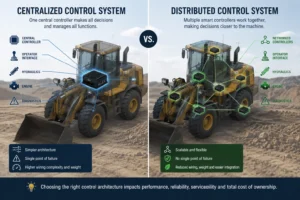
In a centralized architecture, a single main controller handles most of the machine’s control logic. All inputs and outputs—sensors, switches, actuators—are routed back to this central unit.
Advantages
- Simpler conceptual design
- Fewer control nodes
- Easier to understand initially
Limitations
As machines grow in complexity, centralized systems begin to show limitations:
- Increased Wiring Complexity
All signals must route back to one location, resulting in:- Long wiring harnesses
- Higher cost
- More potential failure points
- Limited Scalability
Adding new features or functions becomes more difficult as the system grows. - Single Point of Failure
If the central controller fails, the entire system can be affected. - Integration Constraints
Centralized systems can become difficult to manage when integrating multiple subsystems.
Distributed Control Systems
What It Is?
In a distributed architecture, control functions are spread across multiple modules located throughout the machine.
Each module:
- Handles local inputs and outputs
- Communicates over a network (typically CAN)
- Works as part of a coordinated system
Advantages
- Reduced Wiring Complexity
By placing control modules near the subsystems they manage:
-
- Wiring length is reduced
- Harness complexity decreases
- Installation and serviceability improve
- Improved Reliability
Distributed systems:
-
- Reduce dependency on a single controller
- Isolate failures to specific subsystems
- Better Scalability
New functions can be added by:
-
- Introducing additional modules
- Expanding the network
This is especially valuable for OEMs supporting multiple machine platforms.
- Greater Design Flexibility
Modules can be tailored to:
-
- Specific machine functions
- Different machine sizes
- Varying feature sets
Challenges to Consider
Distributed systems are not without complexity:
- Require robust communication network design
- More components to manage
- Increased need for system-level coordination
However, these challenges are typically outweighed by long-term benefits.
Distributed Control Systems
| Factor | Centralized | Distributed |
| Wiring | High complexity | Reduced complexity |
| Scalability | Limited | Highly scalable |
| Reliability | Single point of failure | More resilient |
| Integration | More difficult at scale | More flexible |
| System growth | Constrained | Easier to expand |
When to Use Each Approach
| Centralized | Distributed |
|
|
In most modern mobile equipment control systems, the trend is clearly toward distributed architectures.
Real-World Considerations for OEMs
When evaluating architecture, OEMs should consider:
- Platform Strategy – Will this system be reused across multiple machines?
- Integration Effort – How many subsystems and vendors need to work together?
- Serviceability – How easy will it be to diagnose and repair in the field?
- Future Expansion – Will new features or attachments be added over time?
The Shift Toward System-Level Design
Historically, many OEMs built systems by selecting individual components and integrating them manually. Today, there is a growing shift toward integrated electronic control systems that provide:
- Coordinated architecture across components
- Simplified integration
- Improved reliability
- Faster development timelines
Instead of deciding architecture in isolation, OEMs can implement systems that are designed from the start to operate as a cohesive whole.
Conclusion
Choosing between centralized and distributed control systems is not just a technical decision—it’s a strategic one. The right architecture can:
- Reduce complexity
- Improve reliability
- Support scalable machine platforms
For most modern mobile equipment applications, distributed systems provide the flexibility and performance needed to support increasing machine complexity.
Let’s Review Your Control System Architecture
Whether you’re designing a new platform or evolving an existing one, a system-level review can help identify opportunities to improve performance and reduce integration risk. Request a System Architecture Review