
Downtime in Emergency Response Is a System-Level Problem
When a utility or municipal vehicle is down, the impact is not limited to the failed component. A snow removal vehicle, refuse truck, bucket truck, sweeper truck, or pumper truck that is unavailable can affect fleet readiness, route completion, emergency response support, infrastructure maintenance, or public-service expectations.
That is why diagnostics and serviceability matter so much in utility and municipal vehicle design.
What OEMs Need to Solve
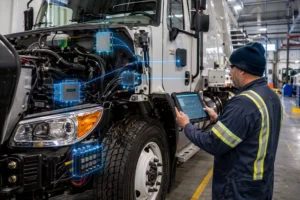 Limited fault visibility can make it harder to isolate whether an issue is electrical, hydraulic, software-related, output-related, power-related, sensor-related, or operator-interface related.
- Long wiring paths and harsh operating exposure can make wiring-related faults difficult to trace.
- Intermittent faults caused by vibration, moisture, salt, corrosion, debris, or load conditions can be difficult for operators and technicians to reproduce.
- Displays and diagnostic tools can give operators and service teams clearer insight into vehicle conditions.
- CAN-based subsystem monitoring can help isolate module, input, output, communication, and vehicle-state issues faster.
Why It Matters
The faster technicians can identify the source of a problem, the faster the vehicle can return to work. Better uptime starts with better visibility, and a smarter controls architecture helps technicians find issues faster while helping OEMs design vehicles that are easier to support in the field.
HED’s Approach
HED helps OEMs improve serviceability by connecting vehicle inputs, outputs, hydraulic functions, operator interfaces, power distribution, and control modules through architectures that support clearer diagnostic visibility. Displays, CAN-based subsystem monitoring, and organized control logic can help technicians narrow down faults faster and give OEM teams a stronger foundation for reducing avoidable downtime.
Key Takeaway
A serviceable control architecture gives technicians a clearer path from fault to fix. For utility and municipal vehicle OEMs, better diagnostic visibility can reduce troubleshooting burden and help keep vehicles available for public-service work.
Improve Utility & Municipal Vehicle Diagnostics and Serviceability