
 The Role of Validation in Harsh Environments
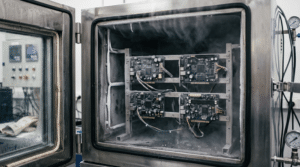 The Role of Validation in Harsh Environments
Validation testing helps OEM engineers evaluate whether electronic controls can withstand harsh operating conditions, reduce field risk, and support reliable machine performance over time.
Electronic controls used in mobile equipment must withstand more than nominal operating conditions. They are exposed to thermal extremes, vibration, moisture, corrosion, electrical transients, and electromagnetic interference—often in combination.
For OEM engineers, validation testing helps determine whether a control design can continue to perform reliably under those stresses over time. Construction, agricultural, municipal, and utility equipment all create conditions that can expose weak points in enclosure design, connectors, internal assemblies, and power protection strategies.
The goal of validation testing is not simply to pass a test. It is to reduce field risk, identify failure modes early, and verify that an electronic control system will perform as expected in real operating environments.
The goal of validation testing is not simply to pass a test. It is to reduce field risk, identify failure modes early, and verify real-world performance.
Why Validation Testing Matters for Electronic Controls
Validation testing is one of the primary ways engineers assess whether an electronic control is ready for real-world use. In harsh mobile applications, reliability cannot be inferred from design intent alone. In practice, validation is guided by internal design requirements, OEM-specific test plans, and applicable environmental and electrical standards. The aim is to understand how the control behaves under stress before equipment reaches the field.
A typical validation program covers:
- Temperature extremes
- Shock and vibration
- Moisture exposure
- Corrosion resistance
- Electromagnetic compatibility
- Electrical transients
- Long-term durability
These tests are most valuable when they are tied to field conditions, mounting constraints, power architecture, sealing strategy, and long-term serviceability. Reliability cannot be inferred from design intent alone. It has to be validated under the conditions the machine will actually face.
Risk to OEMs: The risk of under-validated controls
Choosing a supplier that treats validation as a formality can shift risk directly onto the OEM. Undetected weaknesses in sealing, connectors, solder joints, EMC behavior, or power protection may not appear until machines are already in the field—where failures can create downtime, warranty claims, difficult diagnostics, and customer confidence issues.
Thermal Cycling Testing for Electronic Controls
Mobile equipment rarely operates at a stable temperature. Controls may need to cold-start in winter conditions, operate near engine or hydraulic heat sources, and cool rapidly after shutdown. Thermal cycling helps engineers evaluate how repeated expansion and contraction affect seals, housings, solder joints, connector interfaces, and material compatibility across the operating range.
Typical evaluations include:
- Cold-start performance
- High-temperature operation
- Thermal shock resistance
- Seal integrity during expansion cycles
- Long-term material stability
The objective is not only to confirm operation at high and low temperatures, but to identify whether thermal stress introduces intermittent faults, drift, leakage paths, or long-term degradation that may not be visible during a simple functional check.
Shock and Vibration Testing for Harsh-Environment Controls
Off-highway and vocational equipment can subject mounted electronics to continuous vibration, repetitive shock loads, and abrupt impacts from terrain, attachment movement, or machine operation. Shock and vibration testing helps reveal cracked solder joints, connector back-out, fastener loosening, housing fatigue, and other failures that may appear only after repeated mechanical stress.
Typical evaluations include:
- Connector retention
- Internal component durability
- Mounting integrity
- Solder joint reliability
- Housing performance
Just as important, these tests help engineers assess whether the mounting approach, enclosure design, and connector strategy are appropriate for the actual machine environment rather than idealized laboratory conditions. Shock and vibration testing helps reveal issues that may not appear until a control has experienced repeated mechanical stress in the field.
Risk to OEMs: Mechanical stress exposes supplier shortcuts
If vibration and shock testing are incomplete, weak mounting strategies, poor connector retention, or marginal internal assemblies may survive the lab but fail after repeated machine operation. For OEMs, that can mean intermittent faults that are hard to reproduce, costly service calls, and controls that damage the machine’s reputation—not just the supplier’s.
EMC and EMI Testing in Electronic Control Systems
Modern machines rely on multiple electronic subsystems, including displays, sensors, actuators, radios, charging systems, and networked controllers. EMC and EMI testing helps determine whether a control can operate correctly in that environment without generating unacceptable noise or becoming vulnerable to outside interference.
EMC and EMI testing verifies that electronic controls can:
- Resist outside interference
- Avoid generating disruptive noise
- Operate reliably near motors, alternators, and radios
- Maintain stable communication networks
This becomes especially important in CAN-based architectures, where electromagnetic issues can lead to unstable communication, false inputs, intermittent faults, or behavior that is difficult to diagnose once the machine is in service.
Risk to OEMs: EMI issues are often expensive to find late
Controls that have not been properly validated for electromagnetic compatibility can introduce network instability, false inputs, nuisance faults, or unexpected behavior once integrated with sensors, radios, motors, and other machine electronics. Late discovery can force redesigns, delay launches, and complicate root-cause analysis across the full vehicle system.
Moisture and Corrosion Testing for Electronic Controls
Harsh-environment controls must withstand more than occasional water exposure. In many applications, they are exposed to washdowns, mud, salt, fertilizer, hydraulic fluid, humidity, and repeated condensation cycles.
- Pressure washing
- Mud
- Road salt
- Fertilizer chemicals
- Hydraulic fluids
- Condensation
- Humidity
Typical testing includes:
- Water ingress testing
- Salt spray exposure
- Humidity cycling
- Chemical resistance testing
These tests help evaluate whether sealing systems, venting strategies, coatings, and connector interfaces can maintain performance over time instead of degrading after repeated environmental exposure. Sealing systems, venting strategies, coatings, and connector interfaces all play a role in long-term reliability.
Risk to OEMs: Environmental exposure becomes an OEM problem in the field
When moisture, chemical, or corrosion risks are not validated against real application conditions, failures can appear as degraded connectors, leakage paths, communication errors, or premature control replacement. The OEM may be left managing downtime, service escalation, warranty exposure, and customer dissatisfaction.
Electrical Transient and Load Dump Testing
Vehicle electrical systems are dynamic. Alternators, motors, solenoids, starting systems, and inductive loads can all introduce voltage disturbances that stress control electronics.
Transient and load dump testing verifies that protection strategies are sufficient and that the control can recover from real-world power events without permanent damage or loss of expected function.
Typical testing includes:
- Load dump simulation
- Reverse polarity testing
- Voltage transient exposure
- Power interruption testing
- Short-circuit protection verification
For engineers, this testing is not only about survival. It is also about understanding how the control behaves during undervoltage, overvoltage, restart events, and power interruptions that can affect machine operation or diagnostics.
Risk to OEMs: Power events can turn weak protection into field failures
If transient, load dump, reverse polarity, or short-circuit protection is not validated thoroughly, controls may behave unpredictably during common vehicle electrical events. That risk can show up as no-start conditions, lost diagnostics, component damage, or failures that only appear under specific operating sequences.
Accelerated Life Testing for Long-Term Reliability
Long-term durability cannot be evaluated only through short functional checks. Accelerated life testing compresses years of thermal, electrical, and mechanical stress into shorter test windows so engineers can observe how materials and assemblies age.
Accelerated life testing helps identify:
- Material degradation
- Seal fatigue
- Connector wear
- Component lifespan limitations
- Long-term reliability risks
This kind of testing helps identify wear-out mechanisms, margin limitations, and long-term reliability risks early enough to improve the design before the product is deployed at scale. The strongest validation programs are designed to uncover weaknesses early—before they become field failures, service issues, or warranty costs.
Risk to OEMs: The cheapest supplier can become the most expensive choice
A lower upfront component cost can be outweighed quickly if validation gaps lead to field failures, replacement programs, engineering rework, delayed launches, or loss of customer trust. For OEMs, supplier validation discipline is part of total program risk—not just a purchasing detail.
Validation Testing for Reliability, Not Just Compliance
For OEM engineering teams, validation is more than a checklist item. It helps determine whether a control design has the margin needed for the application, how it interacts with the machine system, and where refinement may still be required.
That includes whether the enclosure and connectors suit the mounting location, whether the power architecture is protected, whether communication remains stable in a noisy electrical environment, and whether the design can be serviced and diagnosed effectively in the field.
A strong validation program helps answer whether:
- The machine will survive harsh environments
- Operators will experience reliable performance
- Downtime will be minimized
- Warranty exposure will be reduced
- Service teams can diagnose issues efficiently
As machine architectures become more software-driven, networked, and electronically dependent, validation becomes even more important.
Electronic controls often sit at the center of machine functionality, diagnostics, operator interface behavior, and network communication. As a result, the quality of the validation process has a direct impact on field reliability.
The strongest programs are not built around proving that a product is ready. They are built around finding where it is not yet robust enough and improving it before field deployment.
Validation Testing as a Critical Part of Field Reliability
For OEM teams evaluating control strategies for harsh-environment equipment, validation testing reduces uncertainty. It translates design assumptions into measured performance data and provides insight into how a control is likely to behave once integrated into the machine.
That is why validation should be treated as an engineering discipline rather than a final checkpoint. The earlier weaknesses are identified, the more effectively they can be addressed through design changes, mounting decisions, connector selection, sealing improvements, or power protection updates.
For teams working through control design or validation requirements, a thorough testing strategy can reduce downstream risk, improve service outcomes, and support more reliable machine performance over time.
For organizations developing or evaluating electronic controls for demanding applications, understanding the purpose and depth of validation is a key part of making sound engineering decisions.
Risk Mitigation for OEMs:
Reduce validation risk by requiring application-specific test plans, reviewing supplier test evidence, validating early, and confirming performance at both the component and system level. The goal is not just to pass a requirement—it is to uncover weaknesses before they become downtime, warranty claims, or customer dissatisfaction.
Working Through Validation Requirements for a Harsh-Environment Control Application?
If your team is defining validation expectations for an electronic control system, it can help to review environmental, mechanical, and electrical risks early in the design process. HED works with OEM teams on control applications for demanding mobile equipment environments. Connect with us to discuss your requirements.