
The Challenge: A CAN-Based System That Wasn’t Delivering the Full Value of CAN
A U.S.-based service and lube truck body OEM had already made the move toward a CAN-based control system, but the results were falling short of what the platform required. For a manufacturer building heavy-duty service trucks used in demanding field environments, the control system needed to do more than operate basic functions. It needed to support reliable crane and outrigger operation, simplify production, improve diagnostics, and give operators a clearer, more capable interface in the field.
The existing system was creating unnecessary limitations. The previous supplier was not delivering the quality or consistency the OEM needed, and the hardware architecture was more complicated than it needed to be. The system relied on an older display, messy mounting, and complex wiring that prevented the OEM from realizing the full advantages of a cleaner CAN-based architecture.
Instead of simplifying the truck, the system added complexity.
That complexity mattered. In service truck applications, electrical architecture directly affects production efficiency, troubleshooting, uptime, and long-term platform flexibility. When a system is difficult to build, difficult to diagnose, or difficult to adapt, the impact reaches beyond engineering. It affects assembly teams, service technicians, operators, fleet customers, and the OEM’s ability to keep improving the vehicle over time.
The Solution: A Cleaner, More Capable Control System Architecture
HED helped the OEM move from a fragmented control setup to a cleaner, more integrated system architecture designed around the realities of service truck operation. The solution included rugged displays and control modules configured to support crane, outrigger, lighting, and truck body functions across the platform.
For the OEM’s newer service truck system, HED supported a full control architecture that included a main control display, cab display, master control module, and additional client control modules for lighting, outriggers, and crane operations.
The system was developed to control crane and outrigger functions while also
supporting diagnostics and logging capabilities. It also needed to interface with third-party control modules, sensors, and a remote — an important requirement for a service truck platform where multiple body systems, operator interfaces, and safety-related functions must work together reliably.
By consolidating control functions and simplifying the wiring approach, HED helped reduce unnecessary harness complexity and create a more repeatable architecture. HED simplified multiple connectors into a cleaner connection strategy, reducing wire harness complexity and potential failure points.
Why It Matters: Better Architecture Creates Better Business Outcomes
For OEMs, wire harness complexity is not just an engineering issue. It can slow assembly, increase the risk of build variability, make troubleshooting harder, and limit how easily new features can be added.
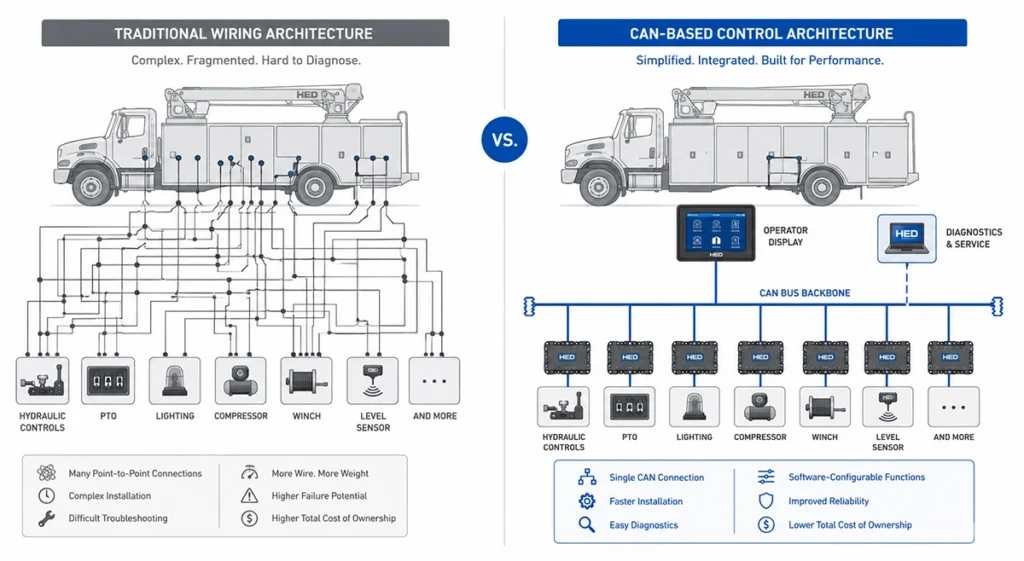
A cleaner CAN-based architecture gives OEMs a more scalable foundation:
- Fewer oversized harnesses
- More modular I/O
- More software-controlled functionality
- Easier diagnostics
- Faster fault isolation
- A stronger path to customer-specific configurations
That matters in service trucks because customization is part of the business. Different customers may need different body layouts, lighting packages, crane options, auxiliary functions, or safety interlocks. Instead of forcing every truck to carry the complexity of every possible feature, a scalable architecture allows functions to be added and adapted more efficiently as requirements change.
The HED system also improved the operator experience. The updated display architecture created a more capable interface for truck functions and gave operators access to more useful information. In service truck applications, that visibility supports faster setup, clearer status awareness, and more confident operation of critical body functions.
The Results: A Stronger Platform for Production, Uptime, and Future Growth
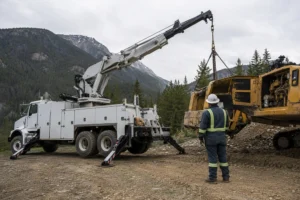 With HED’s support, the OEM gained a cleaner and more scalable control system for its service truck platform. The new architecture improved wire harness design, reduced unnecessary system complexity, and created a stronger foundation for advanced feature automation.
The system enabled features such as automated crane stowing, envelope control, and outrigger-related controls — capabilities that help improve service truck productivity, operator confidence, and jobsite consistency.
The project also delivered a more future-ready platform. HED created the base software system while enabling the OEM’s team to maintain and customize the software going forward. That gave the OEM more control over future changes instead of remaining dependent on a supplier-controlled software model.
HED also supported the customer through training and project execution, helping the OEM build internal confidence with the system and prepare for future programs.
For other service truck OEMs, the takeaway is clear: Electronic controls are not just about replacing switches or adding a display. When designed correctly, they become a platform advantage.
They can simplify production, improve serviceability, support safer and more consistent operation, and give OEMs a more flexible foundation for future customer requirements.
Build Smarter Service Trucks With HED
HED helps service truck OEMs move beyond component-by-component controls and fragmented wiring toward integrated vehicle control systems built for rugged applications, scalable features, and long-term support.
Whether you need a complete system architecture or help improving an existing platform, HED can help you simplify complexity and build a more capable vehicle.
Let’s build a smarter, more serviceable truck platform together. Contact us to discuss your project.