
Beyond reducing harness size, a CAN-based controls architecture gives earthmoving OEMs a better operating model across the product lifecycle. It creates a more scalable platform for machine variants, software-driven feature changes, diagnostics, and future-ready capability.
-
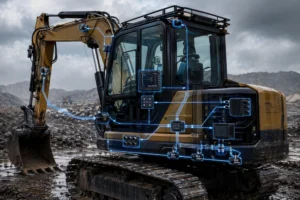
A CAN-based controls architecture creates a scalable foundation for future features, diagnostics, and machine variants. One shared network backbone supports more repeatable builds and more manageable machine variation across options and platforms.
- Adapt machine functions through software instead of redesigning hardware for every change. That can reduce engineering churn and improve responsiveness to program updates.
- Better diagnostics and fault isolation. A CAN-based system can identify module-level faults, open and short circuits, communication issues, and device status more clearly than a hardwired design.
- Easier service and replacement. Distributed modules can be serviced by function area without tracing large sections of machine wiring.
- Cleaner scalability as features grow. Displays, work modes, interlocks, cameras, telematics, and other machine functions can be integrated with less architectural disruption.
- Better control coordination across operator inputs, machine status, and implement functions.
- Stronger long-term lifecycle support for future diagnostics, software enhancements, and platform evolution.
Future-ready earthmoving equipment starts with architecture that can evolve — not just operate on day one.
Read more: Design for uptime – not just operation