
Emergency Vehicle Power Loads Need Coordinated Control
Modern emergency vehicles support more electrical demand than previous generations. Warning lights, scene lighting, patient-area systems, pump-related controls, communication equipment, tool power, HVAC interfaces, chargers, auxiliary outputs, and command equipment all compete for power and operator attention.
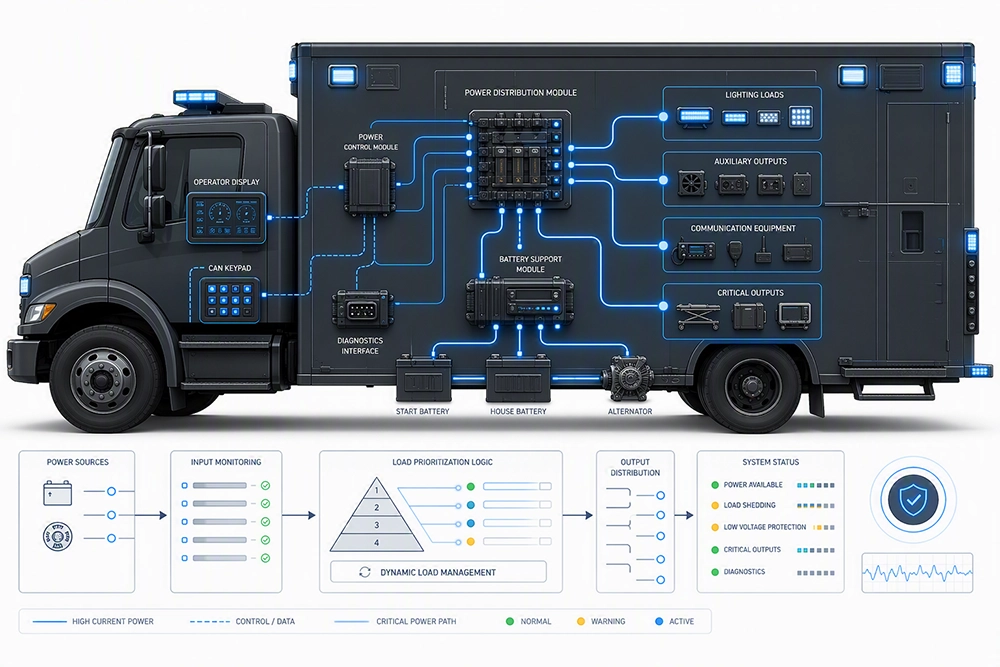
As these loads grow, OEMs need more than added circuits. They need coordinated control logic, protected power distribution, operator feedback, and diagnostics that help keep critical functions available and serviceable.
What OEMs Need to Solve
- Fire apparatus may need coordinated power for warning systems, scene lighting, pump-related functions, compartments, battery support, and auxiliary equipment.
- Ambulances may need reliable power control for patient-area lighting, HVAC-related interfaces, medical-support equipment, communication systems, outlets, and alerts.
- Rescue squads may need to manage tool power, scene lighting, equipment compartments, chargers, auxiliary outputs, and high-demand accessories.
- Mobile command vehicles may need organized power distribution for operator stations, communication support, lighting, climate-related loads, and onboard electronics.
- Load-shedding, low-voltage protection, power-mode logic, and operator alerts can help prioritize critical functions when electrical demand increases.
- Diagnostic visibility into power status, output conditions, and system warnings can make power-related issues easier to understand and service.
Why It Matters
Power load management affects readiness, usability, and serviceability. If high-demand systems are added without coordinated control, OEMs may face nuisance faults, low-voltage events, overloaded circuits, inconsistent operator feedback, and harder-to-diagnose field issues. A smarter power and controls strategy helps emergency vehicles support more capability without allowing electrical complexity to outpace the platform.
HED’s Approach
HED helps OEMs coordinate emergency vehicle power loads with controllers, distributed I/O, operator interfaces, power distribution, and CAN-based diagnostics. This gives engineering teams a stronger foundation for load prioritization, power-state visibility, subsystem control, and future electrical expansion across emergency vehicle families.
Read next: Integrating New Emergency Technologies