
How Smart Keypad Design Influences Operator Experience, Diagnostics, and Machine Architecture
In mobile machine design, the keypad is often viewed as a basic input device. It turns functions on and off. It gives operators a familiar place to control machine features. It does the job. But in modern vehicle electronics, the keypad can play a much larger role.
As machines become more connected, configurable, and software-driven, the keypad becomes one of the most important communication points between the operator and the control system. A smart CAN-based keypad can support operator feedback, diagnostics, serviceability, and long-term platform flexibility.
For OEMs, that makes keypad selection more than a component decision. It becomes part of the machine architecture strategy.

The Keypad as an Operator Communication Tool
Operators need quick, clear feedback from the machine. In high-demand work environments, operators may not have time to search through display screens or interpret complex diagnostic messages. A smart keypad helps bring important status information directly to the operator’s fingertips.
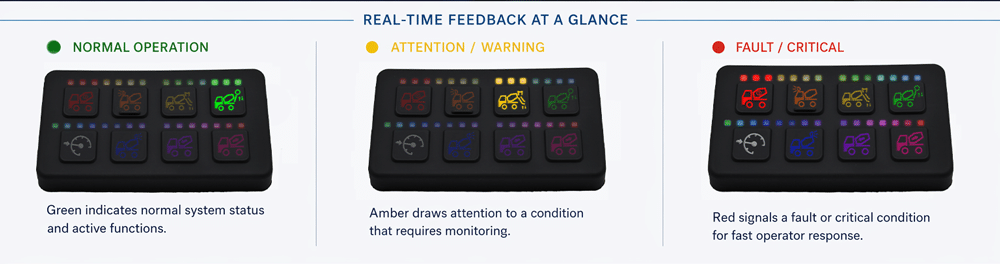
With configurable LED indicators, backlit icons, and bar graph feedback, the keypad can communicate machine conditions in real time.
- Green indicators can show normal operation or active functions.
- Amber indicators can draw attention to warning conditions or functions that require monitoring.
- Red indicators can signal faults, critical conditions, or actions that need immediate operator awareness.
This type of visual feedback helps operators understand machine status at a glance. It also creates a more intuitive control experience by connecting function commands with clear visual confirmation.
LED Feedback That Supports Better Machine Awareness
The HED CL-6000 Series keypad includes individually controlled RGB indicators, dimmable backlit icons, and bar graph capability with LEDs between pairs of buttons delivering a string of 7 LEDs that can show a range or level of command for a function such as speed, level, or fluid temperature range. These features allow the keypad to become part of the machine’s feedback strategy.
Instead of relying only on a display or warning light, OEMs can use the keypad to communicate status, function state, alerts, and condition changes through color and lighting behavior. This can be especially valuable for applications where operators need fast, simple visual cues while staying focused on the work environment.
- Full-spectrum RGB indication
- Dimmable backlighting
- Configurable icon lighting
- Bar graph visual feedback
- Software-defined LED behavior
- Per-button control of indicators and backlit icons
The result is a control interface that communicates, not just actuates.

A Connected Node in the Machine Architecture
A modern keypad does not need to operate as an isolated input device. When connected through CANopen or J1939, the keypad becomes part of the broader vehicle control network. Within a distributed control system, the keypad can communicate with:
- Displays
- Electronic control units
- Telematics devices
- Power distribution modules
- Sensors
- Lighting controls
- Hydraulic control systems
- Transmission or engine controllers
- I/O modules
This allows the keypad to participate in the overall control architecture instead of functioning as a standalone switch panel.
For OEMs designing increasingly connected machines, this matters. A keypad that communicates over the CAN bus can help reduce wiring complexity, support centralized or distributed control strategies, and make it easier to configure functions across multiple vehicle platforms.
Software Integration and Configuration Flexibility
One of the biggest advantages of a smart keypad is the ability to configure behavior through software. Rather than creating a unique hardware layout for every machine variation, OEMs can define how the keypad behaves within the application software. This can include button logic, indicator behavior, icon function, LED color, dimming, and bar graph operation.
Software-configurable keypads can help OEMs support:
- Multiple machine models
- Application-specific feature sets
- Regional or customer-specific configurations
- Future software updates
- Product line expansion
- Reduced hardware variation
This flexibility becomes especially important as OEMs look for ways to standardize control platforms while still supporting different machine requirements.
Diagnostics and Serviceability Benefits
A smart keypad can also support diagnostics and serviceability. Built-in diagnostics and status reporting can help identify system conditions faster. When paired with visual feedback, operators and technicians can better understand whether a function is active, unavailable, in warning status, or related to a fault condition.
This can help support:
- Faster troubleshooting
- Better fault awareness
- Reduced diagnostic guesswork
- Improved operator response
- More efficient maintenance workflows
- Reduced downtime
The keypad can also support faster service through field-replaceable design and standardized connection options. When a keypad is easier to configure, connect, and replace, it can help reduce service complexity for both OEMs and end users.
Built for Future Scalability
Machine platforms continue to evolve. New features, new controls, and new operator feedback requirements often need to be added over time. A software-configurable keypad gives OEMs more flexibility to adapt.
Instead of redesigning the control interface every time a new function is added, OEMs can use configurable keypad behavior to support future machine updates and feature expansion. This makes the keypad a practical part of a scalable electronics strategy.
For OEMs developing families of vehicles or equipment platforms, a configurable keypad can help provide consistency across machines while allowing application-specific control behavior where needed.
Why It Matters for OEMs
The keypad is one of the most visible and frequently used parts of the operator interface. When designed well, it can improve more than the look and feel of the control panel. A smart keypad can help OEMs:
- Improve operator confidence
- Communicate machine status more clearly
- Reduce reliance on hardwired switch logic
- Support CAN-based machine communication
- Enable flexible control configurations
- Simplify service and replacement
- Prepare machine platforms for future features
That combination makes the keypad an important part of the overall machine control strategy.
Key Takeaway
The best keypads do more than accept input.
- They communicate machine status.
- They support diagnostics.
- They simplify architecture.
- They improve operator awareness.
- They help OEMs build more scalable machine platforms.
With configurable LEDs, CAN communication, software-defined behavior, and rugged design, HED’s CL-6000 Series keypads help turn a familiar operator control into a connected part of the machine architecture.
Ready to Rethink the Role of the Keypad?
HED’s CL-6000 Series keypads give OEMs a configurable, CAN-connected operator interface designed for rugged vehicle and machine applications. Use the keypad to support clearer operator feedback, smarter diagnostics, flexible configuration, and scalable machine control architecture.