
Utility & Municipal
Vehicle Control Systems
Reduce Controls Complexity in Utility & Municipal Vehicles
Utility and municipal vehicles perform essential work in demanding public-service environments. Snow removal vehicles, refuse trucks, bucket trucks, sweeper trucks, and pumper trucks must coordinate body equipment, hydraulics, lighting, operator interfaces, interlocks, power distribution, diagnostics, and vehicle-state logic without adding unnecessary electrical complexity.
HED helps utility and municipal vehicle OEMs build rugged, scalable CAN-based control architectures that simplify integration, improve diagnostics, and support more advanced functionality within their vocational vehicle platforms and product families.
Whether you build public works trucks, snow and ice equipment, refuse vehicles, aerial utility trucks, street sweepers, or pumper trucks, HED can help reduce electrical complexity while supporting coordinated vehicle control, operator feedback, service visibility, and future-ready growth within your platform roadmap.
Talk with HED about your next utility or municipal Vehicle platform.
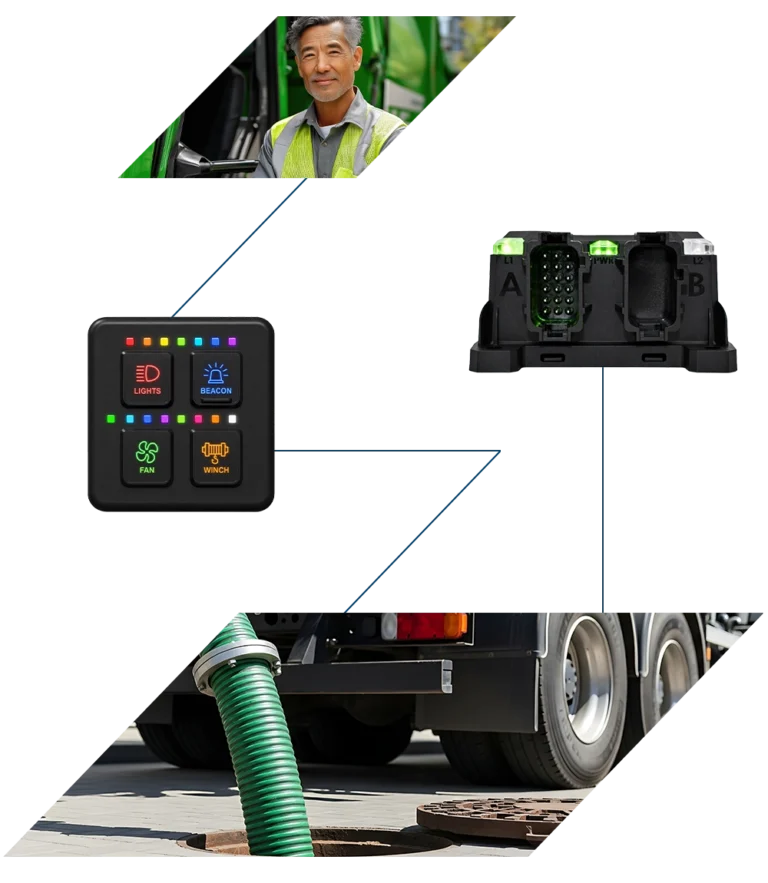
Three Controls Challenges Facing Utility & Municipal Vehicle OEMs
Utility and municipal vehicle OEMs are not simply adding switches, modules, hydraulics, and displays. They are coordinating multiple work functions that must operate reliably across harsh duty cycles, highly configured vehicle bodies, and demanding municipal or utility applications.
Build Vehicle Programs That Can Evolve Without Redesigning the Controls Architecture.
- HED helps OEMs address three core challenges:
- Coordinating complex body, hydraulic, operator-interface, and work-system functions
- Designing rugged electrical architecture for harsh public works and utility environments
- Improving diagnostics, uptime, and serviceability across vehicle fleets, configurations, and related platform variants
Utility and municipal vehicles often rely on multiple systems operating together in real time, from snowplow blades, spreaders, sweepers, pumps, compactors, and booms to lights, alarms, interlocks, displays, and operator commands.
For OEM engineers, the challenge is coordinating those systems without creating a hardwired architecture that is difficult to validate, troubleshoot, or evolve.
Common Engineering Challenges
- Coordinate hydraulic functions, body equipment, auxiliary outputs, warning lights, work lights, interlocks, and operator commands
- Manage high-current loads, sensors, control modules, safety-related logic, and vehicle-state conditions
- Integrate cab controls, body controls, displays, keypads, joysticks, switch panels, and diagnostic feedback
- Support configurable architectures across related truck bodies, municipal specifications, utility applications, and customer options within an OEM’s vehicle program
Risk to OEMs
- Without a scalable controls strategy, every new body layout, boom configuration, plow package, sweeper system, compactor feature, pump option, or customer-specific requirement can add wiring complexity, validation burden, software variation, and long-term service risk.
See how utility and municipal OEMs coordinate body, hydraulic, and work-function controls.
Utility and municipal vehicles operate in some of the most punishing mobile environments. Snow, salt, water, dust, debris, vibration, road spray, washdown, long duty cycles, and repeated seasonal use can all stress electrical systems.
A cleaner electrical architecture can reduce failure points, simplify routing, and make troubleshooting easier when vehicles need to stay in service.
Common Engineering Challenges
- Withstand vibration, moisture, salt, corrosion, temperature extremes, debris, washdown, and continuous-duty operation
- Reduce long harness runs across chassis, frames, bodies, booms, hoppers, tanks, pump panels, and work-equipment areas
- Protect wiring, connectors, and modules around hydraulic systems, moving structures, body equipment, and harsh exposure zones
- Improve service access and reliability for municipalities, utilities, dealers, fleets, and field technicians
Risk to OEMs
- If the electrical system is difficult to service or vulnerable to harsh environmental exposure, OEMs may face more warranty claims, longer troubleshooting cycles, dissatisfied fleet customers, and reduced confidence in the vehicle platform.
Explore ways to reduce wiring risk in harsh public works and utility environments.
Utility and municipal vehicle downtime can affect critical public services. A snowplow out of service during a storm, a refuse truck sidelined during a route, a bucket truck unavailable for utility work, or a sweeper down during seasonal maintenance can create operational disruption.
As vehicle functionality increases, OEMs need clearer diagnostics and faster fault isolation across sensors, modules, work functions, power circuits, hydraulic outputs, communication networks, and operator interfaces.
Common Engineering Challenges
- Improve fault visibility across cab, chassis, body, lighting, hydraulic, pump, compactor, sweeper, spreader, boom, and auxiliary systems
- Shorten troubleshooting cycles for wiring, sensors, modules, outputs, communication faults, and machine-state logic
- Give fleet technicians clearer service information for intermittent or hard-to-reproduce faults
- Support more serviceable architectures as customer options, vehicle sophistication, and fleet expectations increase
Risk to OEMs
- Poor diagnostics can turn a small electrical or control issue into a long service event, increasing downtime, warranty exposure, repeat troubleshooting, and customer frustration.
See how diagnostics and service visibility help keep utility and municipal fleets in service.
HED helps utility and municipal vehicle OEMs reduce control-system complexity with rugged, scalable electronic architectures that connect body functions, hydraulic functions, operator interfaces, diagnostics, power distribution, and future feature growth through a cleaner CAN-based platform.
For engineering teams, the value is not just in the individual components. It is in how those technologies work together to simplify integration, improve service visibility, and create a more repeatable controls foundation across related models, configurations, and option packages within an OEM’s vehicle family.
- Coordinate work functions, body outputs, hydraulic logic, operator commands, sensors, diagnostics, and vehicle-state control through controllers and distributed I/O modules placed closer to key function areas.
- Give operators and service teams clearer visibility into vehicle status, fault messages, warnings, operating modes, configuration data, and service information through rugged displays.
- Simplify operator controls for plows, spreaders, sweepers, pumps, booms, compactors, work lights, auxiliary equipment, and service functions with CAN keypads that reduce wiring complexity.
- Support cleaner electrical architecture by connecting vehicle inputs, outputs, operator interfaces, diagnostics, and future feature expansion through a unified CAN-based control platform within the OEM’s vehicle program.
- Help OEMs create a more repeatable controls strategy for engineering, manufacturing, validation, service, and long-term planning across their vehicle platforms and product families.
Proven value across Utility & Municipal Vehicle Platforms
Utility and municipal vehicle applications share many similar control needs, but each OEM platform still requires vehicle-specific functionality. HED helps OEMs apply a common controls foundation within their vehicle programs while configuring application-specific features in software.
Snow Removal Vehicles
Coordinate plow controls, wing plows, spreaders, brine systems, warning lights, work lights, hydraulic outputs, operator interfaces, and diagnostics. Improve visibility into vehicle status, spreader function, lighting, hydraulic control, and service information during demanding winter operations.
Refuse Trucks
Support compactor controls, body functions, lift systems, hopper-related logic, lighting, alarms, interlocks, operator feedback, and diagnostics. Reduce electrical variation across refuse configurations while improving fault visibility and serviceability.
Bucket Trucks
Coordinate boom controls, outrigger/stabilizer logic, platform controls, ground controls, interlocks, lighting, alarms, hydraulic functions, and operator feedback. Support clearer control integration across chassis, body, boom, and work-zone systems.
Sweeper Trucks
Integrate broom controls, vacuum systems, water spray, debris handling, lighting, alarms, operator displays, and diagnostic feedback. Improve control consistency and service visibility across street sweeping, municipal cleaning, and road maintenance applications.
Pumper Trucks
Coordinate pump controls, tank systems, valves, lighting, auxiliary outputs, operator panels, interlocks, alarms, and service diagnostics. Support more organized control architecture across power, fluid handling, operator interface, and vehicle-state systems.
Smarter Control
As utility and municipal vehicle programs become more capable, OEMs need control architectures that can support new features, option packages, and model updates without adding unnecessary wiring, custom logic, or one-off integration within each vehicle program.
A scalable controls platform helps OEMs:
- Coordinate complex body, hydraulic, power, operator-interface, and diagnostic functions
- Reduce wiring complexity and electrical variants across related models, configurations, and option packages
- Simplify manufacturing, validation, service, and software-driven feature configuration
- Support future diagnostics, connectivity, fleet visibility, and next-generation growth within an OEM’s platform roadmap
The goal is a vehicle architecture that can handle utility and municipal vehicle complexity without allowing engineering complexity to grow at the same rate.

Related Utility & Municipal Vehicle Control Topics
For OEM teams evaluating electrical and control architecture, these supporting pages take a deeper look at common engineering challenges behind work-function coordination, rugged reliability, platform scalability within an OEM vehicle program, and serviceability.
Ready to Simplify Your Next Utility or Municipal Vehicle Platform?
Let’s discuss how HED can help reduce electrical complexity, improve diagnostics, and support rugged CAN-based control architectures within your next utility or municipal vehicle platform.