
Airport Operations Depend on Equipment Availability
Ground support fleets operate around tight aircraft turnaround windows, where a belt loader that will not raise, a cargo loader with a deck-position fault, a catering truck with an intermittent lift issue, or a de-icing vehicle with a pump or boom fault can quickly disrupt ramp operations.
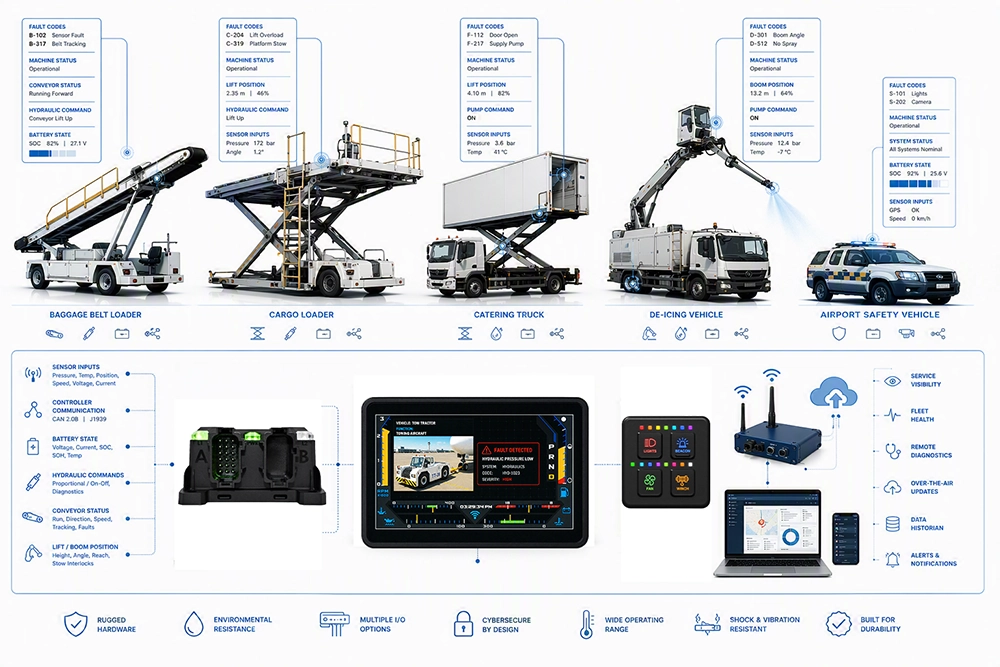
OEMs need diagnostic strategies that give technicians clear visibility into machine state, controller communication, input and output status, sensor signals, hydraulic commands, battery condition, and operator-interface messages before a service event turns into extended downtime.
What OEMs Need to Solve
- Show technicians whether the issue is tied to a conveyor motor, lift cylinder, deck sensor, stabilizer input, boom position, pump command, battery state, or controller communication fault
- Monitor baggage-loader conveyors, cargo-loader deck functions, catering-truck lifts, de-icing booms and spray systems, safety-vehicle warning systems, and auxiliary power loads
- Provide fault codes, status screens, and telematics-ready data that help dealers, fleet maintenance teams, and OEM support teams troubleshoot without starting from zero
- Reduce repeat service calls caused by intermittent wiring faults, corroded connectors, unclear operator messages, environmental exposure, or hard-to-reproduce hydraulic behavior
- Capture machine history that helps OEMs improve service documentation, warranty analysis, fleet maintenance planning, and future product design
Why It Matters
Every minute of downtime can affect baggage movement, cargo transfer, catering service, aircraft de-icing, emergency response readiness, and gate turnaround performance. Better diagnostics help OEMs give customers faster answers when equipment is under pressure.
HED’s Approach
HED helps OEMs build diagnostic-ready control architectures that connect machine inputs, outputs, operator interfaces, controllers, distributed I/O, displays, CAN keypads, sensors, and communication networks through a coordinated CAN-based platform. For airport equipment, that means technicians can get clearer visibility into the systems that matter most on the ramp, such as conveyor operation, lift position, deck sensors, stabilizer inputs, boom movement, pump commands, battery status, interlocks, and communication faults. HED’s approach helps OEMs design service visibility into the architecture from the beginning instead of adding diagnostics as an afterthought.
Need better diagnostic visibility on your next airport equipment platform?
Contact HED to talk through your control system requirements.
Read next: Managing electrical load growth in airport ground support equipment