
Modern Airport Vehicles Need Smarter Power Management
Airport equipment is adding more electrical demand at the same time many fleets are moving toward electric, hybrid, or low-emission platforms.
Baggage loaders, cargo loaders, catering trucks, de-icing vehicles, safety vehicles, lavatory and water service trucks, mobile ground power units, and other GSE platforms all need smarter ways to manage batteries, alternators, pumps, heaters, lighting, warning systems, displays, sensors, and auxiliary loads.
What OEMs Need to Solve
- Monitor battery state, charging status, alternator output, auxiliary loads, and electrified subsystem demand
- Prioritize critical functions such as lift enable, conveyor operation, warning lights, cab controls, pump operation, heater control, and safety-vehicle response systems
- Reduce wiring complexity by placing I/O closer to high-demand function areas such as conveyors, lift decks, pump stations, boom assemblies, lighting clusters, and operator stations
- Improve energy-aware behavior for electric belt loaders, cargo tractors, de-icing systems, catering lifts, and other high-duty-cycle airport equipment
- Prepare equipment platforms for future electric, hybrid, battery-management, charging, and telematics requirements
Why It Matters
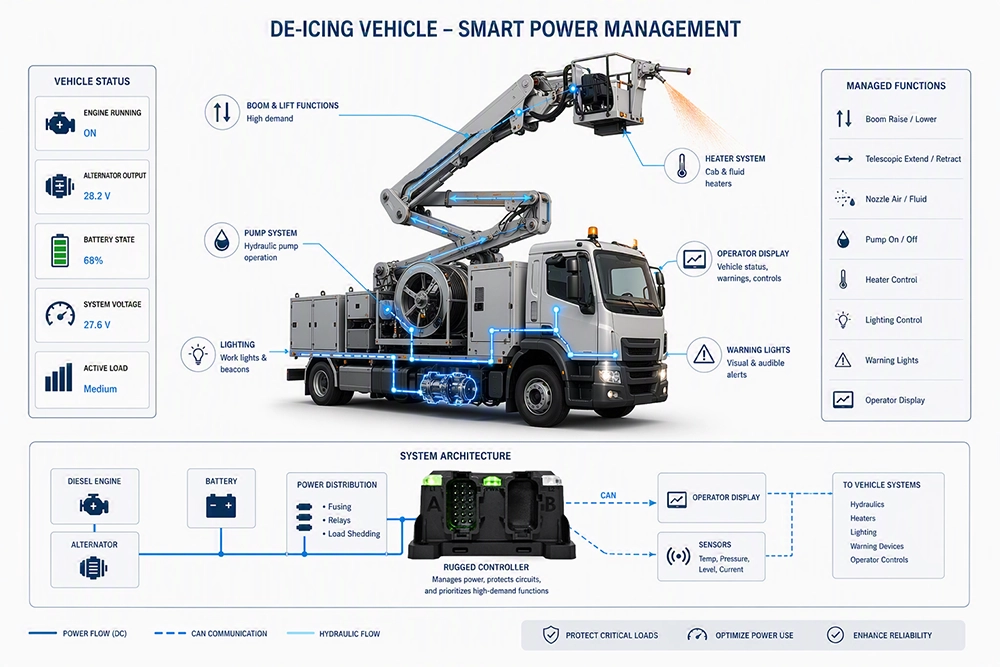
Electrification does not affect every airport machine the same way. A baggage loader may need efficient conveyor and lift control, a de-icing vehicle may need coordinated heater, pump, boom, and fluid-delivery loads, and a safety vehicle may need reliable auxiliary power for warning and communication systems. OEMs need architectures that can manage today’s loads while leaving room for the next generation of equipment requirements.
HED’s Approach
HED helps OEMs organize power distribution, load management, operator interfaces, diagnostics, and controlled outputs within a cleaner CAN-based architecture. Controllers, distributed I/O, displays, CAN keypads, and power-management strategies can work together to monitor battery and charging data, prioritize critical loads, reduce long wire runs, and support energy-aware machine behavior. For airport equipment OEMs, this provides a practical foundation for today’s high-demand electrical systems while leaving room for future electric, hybrid, battery-management, charging, and telematics requirements.
Planning for higher electrical loads, electrification, or smarter power distribution?
Contact HED to discuss the right control architecture for your equipment program.
Read next: Coordinated controls help hydraulics, interlocks, and operator commands work together.