
Coordinate Machine Functions, Hydraulics, Interlocks, and Operator Commands
Airport ground support equipment often performs several functions at once: a belt loader raises and runs a conveyor near an aircraft door, a cargo loader positions lift decks and transfer rollers, a catering truck lifts a service body into position, and a de-icing vehicle coordinates boom movement, fluid delivery, pump output, heat, and operator commands.
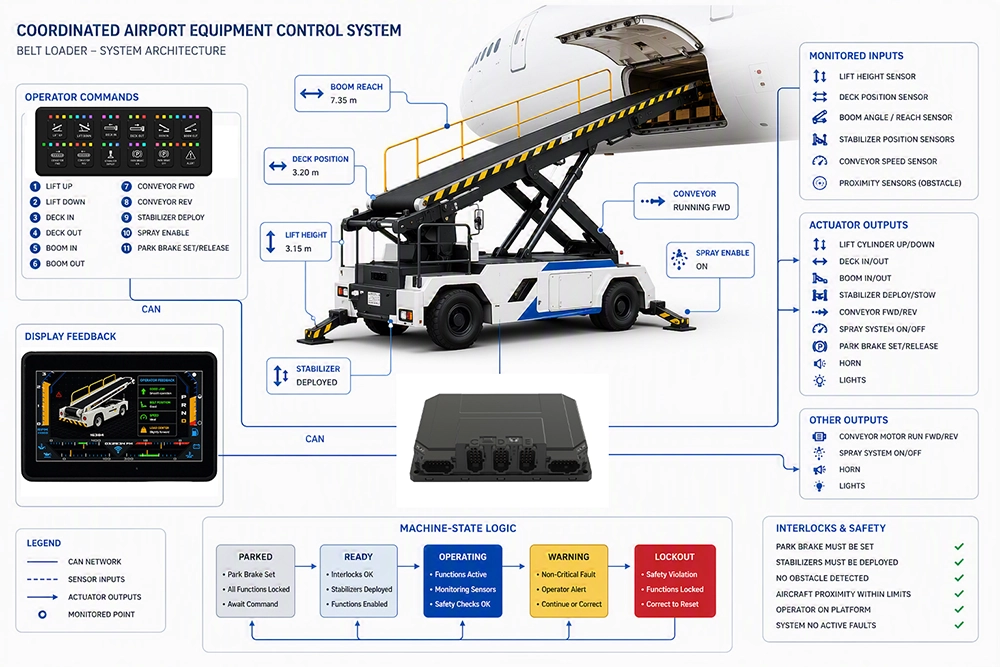
For OEMs, the challenge is making sure hydraulic movement, operator inputs, machine-state logic, sensors, interlocks, alarms, displays, and auxiliary functions work together through one predictable, diagnosable control strategy that fits the way each machine actually operates on the ramp.
What OEMs Need to Solve
- Coordinate belt-loader conveyor raise/lower functions, cargo-loader lift decks and transfer systems, catering-truck body lifts and stabilizers, de-icing booms and spray systems, and safety-vehicle lighting, pumps, and auxiliary functions
- Integrate operator commands, CAN keypads, displays, proximity or position sensors, hydraulic valve outputs, feedback signals, and machine-state logic
- Build interlock strategies for lift height, deck position, stabilizer deployment, boom reach, conveyor operation, spray enable, vehicle speed, park brake state, and aircraft-approach conditions
- Give operators clearer visibility into enabled states, active functions, warnings, faults, lockouts, hydraulic commands, and next-step machine behavior
- Simplify validation and troubleshooting by using consistent control logic across related machine configurations while preserving equipment-specific behavior
Why It Matters
When vehicle functions are controlled in isolation, OEMs can face inconsistent operator behavior, harder validation, more wiring complexity, unclear fault paths, and higher service risk. Coordinated control logic helps make complex ramp equipment easier to operate, especially when hydraulic movement, aircraft proximity, operator visibility, and machine lockouts all have to work together.
HED’s Approach
HED helps OEMs coordinate operator input, machine logic, hydraulic outputs, interlocks, sensors, diagnostics, and controlled functions through a unified CAN-based architecture. Controllers and distributed I/O can be placed closer to key function areas, while displays and CAN keypads give operators clearer feedback for enabled states, warnings, lockouts, modes, and next-step machine behavior. For airport equipment such as belt loaders, cargo loaders, catering trucks, de-icing vehicles, and safety vehicles, this helps OEMs create more predictable control logic for conveyor movement, lift sequencing, deck positioning, stabilizer deployment, boom control, spray enable, pump operation, lighting, alarms, and aircraft-facing machine functions.
Working through complex hydraulic functions, interlocks, or operator-input logic?
Contact HED to explore a coordinated control strategy for your airport equipment platform.
Read next: How scalable controls support future airport equipment features without redesign.