
Scale a common controls platform across pavers, graders, rollers, sweepers, and configurable machine variants
Road building OEMs often need to support multiple machine types, option packages, and customer-specific configurations without multiplying electrical architectures. A standardized controls platform helps OEMs build consistency across fleets while still allowing each machine to be configured for its job.
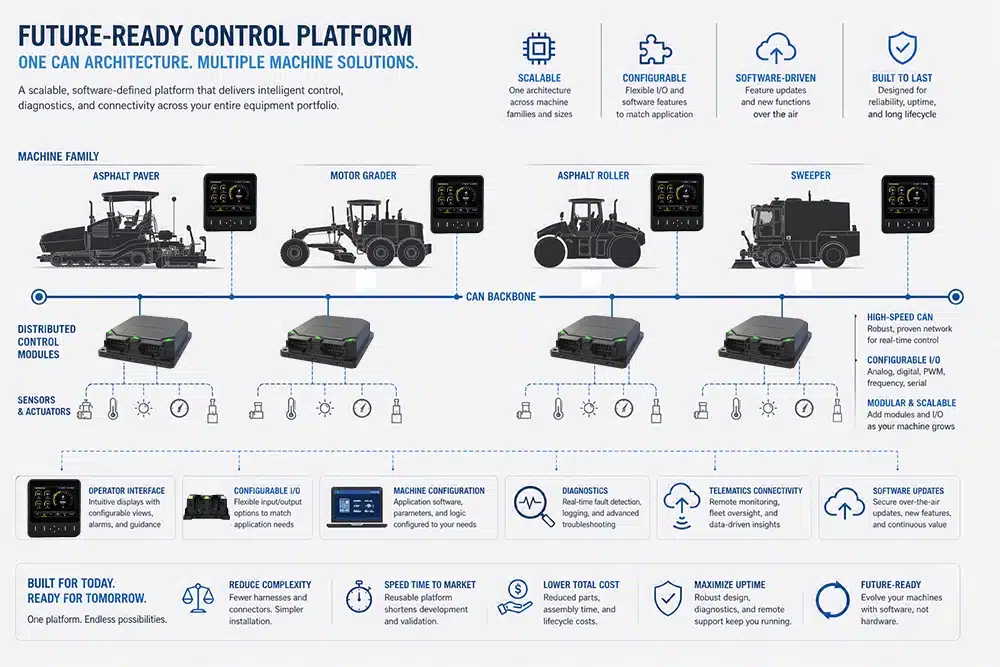
- Create a common CAN backbone that can support pavers, graders, rollers, sweepers, and related road surface equipment.
- Use configurable I/O and software logic to tailor machine behavior without creating a unique harness strategy for every option set.
- Reduce engineering churn by reusing proven modules, operator interfaces, displays, and control logic across related platforms.
- Simplify procurement and inventory by reducing the number of one-off electrical components and harness variations.
- Support cleaner configure-to-order builds by adding capability at the edge when the machine configuration requires it.
- Improve service familiarity across the fleet so technicians can diagnose related machines using a more consistent architecture.
Fleet standardization gives OEMs a stronger foundation for product growth. Instead of designing each machine as a separate electrical project, teams can scale a common architecture across models, options, and future upgrades.
Read More: Consistent Paving Performance