
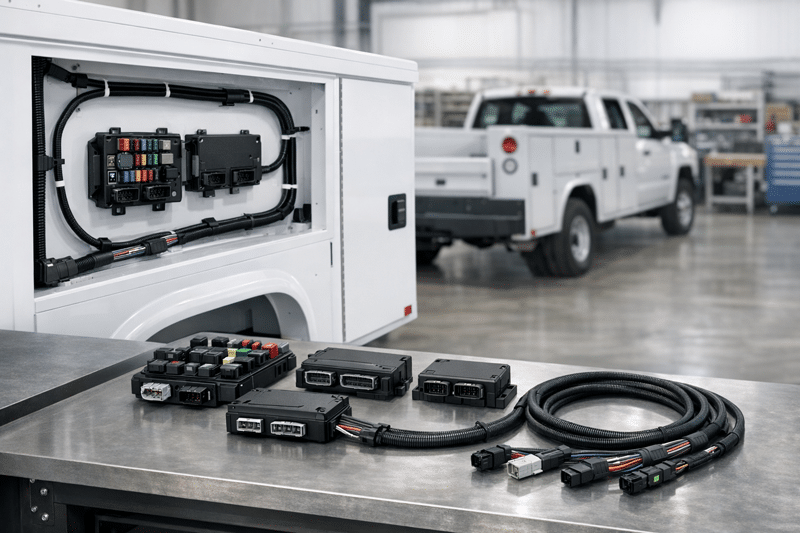
 For a typical OEM, simplifying the electrical architecture can create meaningful bottom-line impact across labor, inventory, responsiveness, and customer satisfaction.
Because wire harness assembly and routing remain labor-intensive, and because excess inventory commonly carries annual holding costs in the high teens to mid-thirties as a percent of inventory value, reducing harness complexity and moving to configurable modules can lower build hours, reduce carrying cost, improve throughput, and reduce the sales lost when trucks cannot be configured quickly to match customer needs.
- Smaller harnesses. Faster routing. Cutting harness size and branch complexity can remove labor from every build—often measured in hours per truck across routing, securing, testing, and rework. That directly lowers direct labor cost, improves line throughput, and reduces schedule disruption caused by wiring bottlenecks.
- Fewer holes and keep-out areas in the service body. A cleaner architecture frees usable packaging space for compartments, options, and customer-specific layouts. The financial impact is not just material and labor avoidance—it is the ability to win more jobs by saying yes to more configurations without forcing costly body redesign tradeoffs.
- More usable space for customer-specific options and layouts. When the body is not constrained by oversized harness paths, OEMs can offer more differentiated features and preserve margin on higher-value builds. The cost of not solving this is lost revenue, lower option attach, and customer frustration when desired layouts cannot be supported.
- Add I/O modules as features are ordered—not in every truck. Instead of carrying the cost of a fully loaded harness on every unit, OEMs can add capability only when the order requires it. That reduces overbuilt content, lowers inventory exposure, and helps avoid the excess carrying cost, obsolescence risk, and working capital drag of stocking parts for features not every customer buys.
Read more: Future-proof your work trucks