
Service Truck
Control Solutions
Integrated Control Systems for Smarter Work Trucks.
Simplify electrical architecture, support advanced truck functions, and improve uptime in the field.
Modern service trucks require more than discrete components. They require an integrated controls architecture that can manage complex body functions, reduce wiring burden, and support repeatable vehicle platforms.
HED helps OEMs move from fragmented hardwired designs to CAN-based control systems that simplify integration, support diagnostics, and create a stronger foundation for future vehicle capability.
Ready to simplify your work truck control architecture?
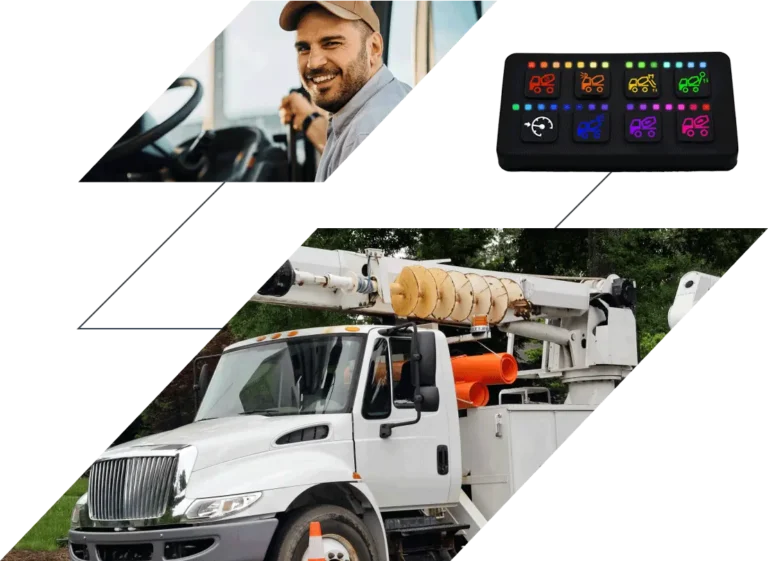
Why Legacy Electrical Systems Fall Short
Many service trucks still rely on hardwired and relay-based architectures that become increasingly difficult to scale as vehicle functionality expands.
As truck body functions, interlocks, and operator requirements increase, legacy designs add engineering burden, complicate production, and make future upgrades more disruptive.
- Hardwired systems that become harder to manage as functions grow
- More wiring complexity, more integration effort, and more opportunity for failure
- Limited diagnostics when troubleshooting speed matters most
- Slower service and reduced uptime in the field
Designed for the Demands of Service Truck Applications
Service trucks must coordinate multiple body functions, operator interfaces, and vehicle signals in demanding environments. HED helps OEMs bring these systems together in a scalable architecture.
- From crane control and outriggers to lighting, locks, compartment management and operator interfaces, these functions depend on clean integration and repeatable system design.
- Crane and outrigger control
- Lighting, locks, and compartment status
- Operator interfaces and system feedback
Why OEMs Choose HED
HED delivers rugged CAN-based control systems for vocational vehicles that help OEMs move beyond component-by-component integration.
By combining controllers, displays, keypads, and system design support, HED helps OEMs build a more integrated vehicle architecture that can help solve your biggest challenges.
Read: Electronics turn maintenance trucks into service assets
- Simplifies electrical architecture across the vehicle
- Reduces wiring and integration complexity
- Supports diagnostics, serviceability, and future expansion
- Lowers the total cost of ownership
HED helps OEMs reduce harness complexity, standardize architecture, and support advanced vehicle functions without expanding internal controls resources.
- Reduce engineering burden on new and existing programs
- Support faster, more repeatable vehicle builds
- Create a more scalable platform for future variants
Read: Bottom-line impact of simplifying electrical architecture
Modern work trucks require a control architecture that can coordinate body equipment, operator inputs, diagnostics, and future feature additions without repeated redesign.
- Support integrated control across key truck functions
- Improve visibility through built-in diagnostics
- Make it easier to expand capability over time
A better controls architecture does more than simplify design. It helps reduce failure points, speed fault isolation, and keep trucks available for productive work.
- Reduce troubleshooting and service time
- Improve serviceability through better diagnostics
- Lower lifecycle complexity across the platform
A Clearer Path Forward
Traditional work truck electrical systems become harder to manage as trucks become more capable. HED helps OEMs move to an integrated controls approach built for scalability, diagnostics, and long-term support.
Traditional Approach
- Custom relay systems
- Increasing wiring complexity
- Limited diagnostics
- Slow troubleshooting
- Difficult upgrades

With HED
- Integrated control system
- Simplified architecture
- Built-in diagnostics
- Faster troubleshooting
- Platform for future innovation
Why HED
HED combines rugged products, full-system controls expertise, and application support to help OEMs design more capable vehicles with less integration risk.
- Rugged controllers, displays, and keypads designed for demanding mobile environments
- Full-system design support to streamline procurement and integration
- Long-term product and application support for extended vehicle lifecycles

Planning Your Next Work Truck Platform?
If you are looking to simplify electrical architecture, support more advanced truck functions, or reduce integration risk on your next program, HED can help.
Let’s discuss how an integrated controls approach can support your architecture, production goals, and long-term platform strategy.