
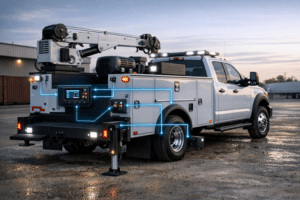
 On a maintenance service truck, the value of vehicle electronics is measured by how reliably the truck itself performs its daily job. Built-in controls, interlocks, module-level diagnostics, and reduced harness complexity help keep critical truck functions working—such as PTO operation, outriggers, crane enable logic, lighting, battery protection, and operator controls. That means fewer truck-related failures, faster repairs when problems occur, and more uptime from the service vehicle itself.
- Keep PTO-dependent functions available and working correctly. Electronic control of PTO-related logic helps prevent out-of-sequence operation, nuisance shutdowns, and hard-to-trace wiring faults that can take cranes, compressors, generators, or hydraulic functions out of service.
- Reduce crane and outrigger downtime caused by interlock or wiring issues. When outrigger status, crane enable conditions, and related safety logic are managed electronically, faults can be isolated faster and improper states can be identified clearly. That reduces time spent chasing interlock problems and gets the truck back to safe operation sooner.
- Protect battery power and prevent no-start or low-voltage events. Electronics can manage load prioritization, voltage monitoring, and protection logic for work lights, auxiliary loads, compressors, and control modules. That helps prevent battery drain, unstable voltage conditions, and avoidable no-start situations that take the truck out of service.
- Shorten repair time on the truck’s own body functions. Built-in diagnostics make it easier to isolate faults in lighting, locks, compartment status, switches, and auxiliary controls without tracing large sections of hardwired circuits. That lowers troubleshooting labor and improves first-time fix rates on the truck itself.
- Reduce failures caused by harness wear, splices, and connection points. Maintenance trucks operate in vibration, weather, dirt, and repeated use cycles. Simplified electronics architectures with fewer wire runs and fewer failure points reduce intermittent faults, corrosion-related issues, and repair events caused by harness complexity.
- Prevent operator misuse that creates avoidable service events. Electronic sequencing, interlocks, and status visibility help ensure the truck is operated correctly during setup and use. That reduces faults caused by missed steps, improper operation, or unsafe equipment states that can otherwise lead to downtime.
- Make service on the truck more modular and repeatable. When faults can be isolated to a module, function group, or input/output area, technicians can repair the maintenance truck faster and with less disassembly than in a traditional hardwired architecture.
- Improve uptime of the maintenance truck as a revenue-producing service asset. When the truck’s controls, diagnostics, and protection logic reduce failures and shorten repairs, the truck spends more time available for dispatch and less time waiting on electrical troubleshooting or body-function repair.
For maintenance trucks, the value of vehicle electronics is straightforward: better control of truck functions, fewer wiring-related failures, clearer diagnostics, faster repairs, and less downtime of the truck itself. Actual savings will vary by duty cycle and application, but the operational benefit is clear—electronics help the maintenance truck stay available, functional, and ready for work.
Read more: Bottom-line impact of simplifying electrical architecture in Service Work Trucks