
As lifting equipment adds more sensors, operator features, lighting, cameras, interlocks, hydraulic or electric functions, telematics, and option packages, hardwired architecture can become difficult to route, assemble, troubleshoot, and scale. HED helps OEMs simplify electrical architecture with distributed I/O, CAN-based communication, rugged operator interfaces, and configurable control logic that reduce the amount of custom wiring required for each machine build.
- Reduce harness bulk, branch complexity, routing time, connector count, and crowded pass-throughs across lift platforms.
- Move more capability into configurable modules and software instead of adding relays, switches, and point-to-point wiring for every new function.
- Improve build repeatability across cranes, telehandlers, lifts, forklifts, and machine variants with a more standardized electrical strategy.
- Support configurable options without redesigning the entire harness or overbuilding every machine for every possible feature.
- Make functions easier to connect, test, diagnose, and validate before shipment, reducing assembly errors and rework.
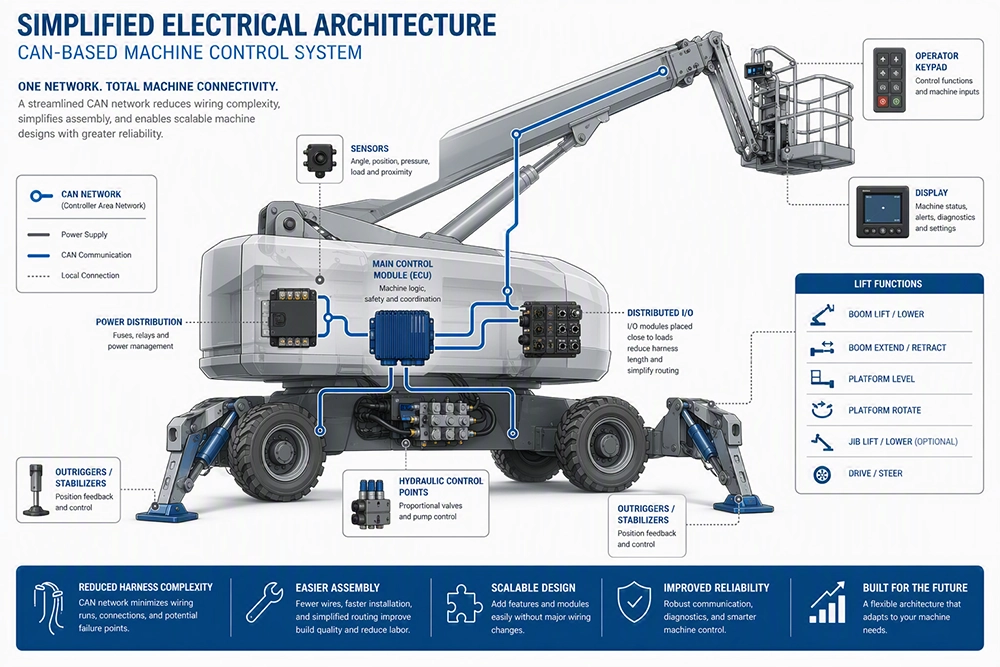
The practical value is a cleaner machine architecture: fewer wires to route, fewer connections to manage, less build variation, and a clearer path to add capability without dragging unnecessary electrical complexity into every lifting platform.