
Airport Ground Support
Equipment Control
Systems
Smarter Controls for Airport Ground Support Equipment
Airport ground support equipment operates in one of the most demanding vehicle environments in the world. Machines must perform reliably around aircraft, passengers, ground crews, tight gate schedules, extreme weather, and high-utilization fleet demands.
For OEMs, the challenge is not just controlling a vehicle function. It is designing a control architecture that supports uptime, operator awareness, electrical load management, hydraulic coordination, diagnostics, and future capability growth as airport equipment becomes more connected, configurable, and feature-rich.
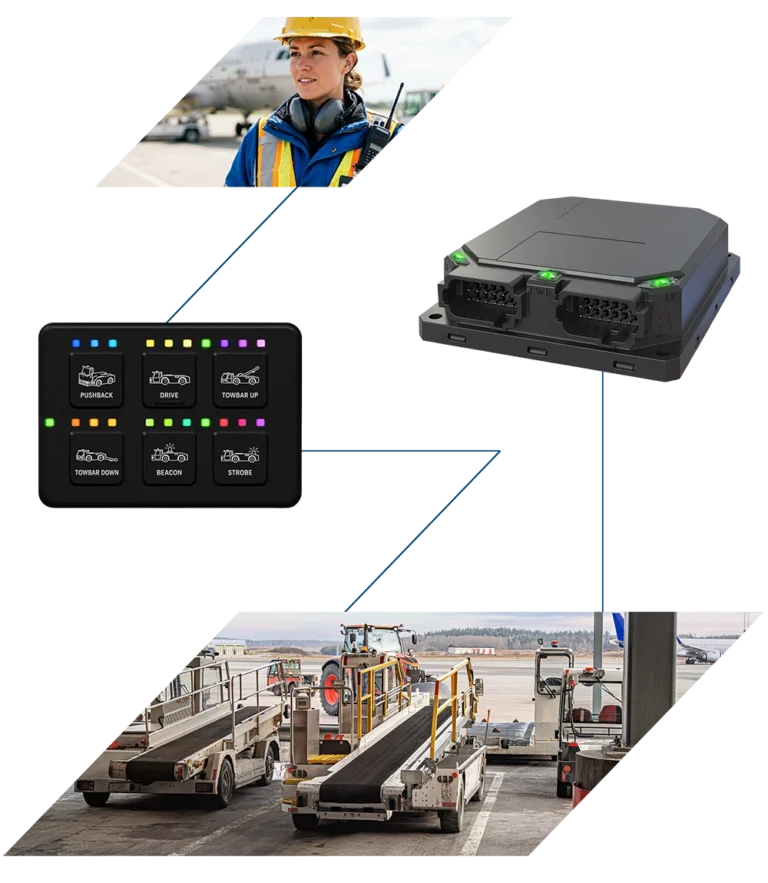
HED helps airport equipment OEMs build rugged, scalable CAN-based control architectures for baggage loaders, cargo loaders, catering trucks, de-icing vehicles, airport safety vehicles, and other ground support equipment. Our control modules, displays, CAN keypads, distributed I/O, and telematics-ready system architectures help reduce electrical complexity while improving service visibility, operator confidence, and long-term platform flexibility.
Four Controls Priorities Facing Airport Equipment OEMs
Airport equipment OEMs are designing vehicles for environments where downtime, service delays, aircraft proximity, and electrical complexity all carry real operational consequences.
Engineering teams are being asked to build equipment that is easier to diagnose, safer to operate, more energy-aware, and better prepared for new features, configurations, and connected-service expectations over time.
- HED helps OEMs address four airport equipment control priorities:
- Improving uptime with clearer diagnostics and service visibility
- Managing power distribution, electrical loads, and electrification readiness
- Coordinating vehicle functions, hydraulics, interlocks, and operator inputs
- Building scalable control architectures that support future machine capabilities, feature growth, and customer-specific configurations
Airport equipment runs on tight turnaround schedules. When a baggage loader, cargo loader, catering truck, de-icing vehicle, or safety vehicle is down, the impact can ripple across ramp operations, maintenance planning, and fleet utilization.
For OEM engineers, uptime starts with control architecture that shows machine status, faults, signals, hydraulic functions, operator inputs, and subsystem communication clearly.
Common Engineering Challenges
- Improve fault visibility across electrical, hydraulic, sensor, actuator, and communication systems
- Help technicians isolate likely failure points faster during high-pressure service events
- Monitor controllers, I/O, operator interfaces, interlocks, battery status, and machine-state conditions
- Reduce repeat troubleshooting from intermittent faults, wiring issues, exposure, or unclear messages
- Capture machine data for dealer service, maintenance, warranty analysis, and product improvement
Risk to OEMs
- If airport equipment is difficult to diagnose, small issues can become long service events, increasing downtime, warranty exposure, and customer frustration during time-sensitive airport operations.
Learn how diagnostic-ready controls help isolate airport equipment faults faster.
Airport fleets are adding electrical demand while preparing for electric, hybrid, and low-emission platforms. Ground support vehicles now carry more loads, interfaces, sensors, warning systems, lighting, pumps, lifts, conveyors, heaters, and connected features.
OEMs need architectures that manage today’s electrical complexity while preparing platforms for future electrification requirements.
Common Engineering Challenges
- Manage growing electrical loads across vehicle functions, accessories, and critical systems
- Support battery monitoring, load prioritization, power distribution, and energy-aware behavior
- Coordinate actuators, hydraulic power units, pumps, lighting, warnings, displays, and auxiliary systems
- Prepare platforms for electric, hybrid, or low-emission variants
- Reduce redesign risk as airport fleet electrification requirements evolve
Risk to OEMs
- Without a scalable power-management strategy, electrification and added vehicle features can increase wiring complexity, reduce operating efficiency, create service challenges, and force expensive platform redesigns.
Explore control strategies for managing electrical load growth in airport ground support equipment.
Airport ground support equipment depends on precise coordination among operators, hydraulic systems, interlocks, vehicle movement, and aircraft-facing functions. Lifts, conveyors, booms, platforms, stabilizers, pumps, spray systems, and warnings cannot be treated as isolated control points.
For OEMs, the goal is predictable, diagnosable, repeatable control behavior across related machine configurations.
Common Engineering Challenges
- Coordinate lifts, conveyors, decks, booms, stabilizers, pumps, platforms, lighting, alarms, and auxiliary functions
- Integrate inputs, displays, CAN keypads, sensors, interlocks, valve outputs, feedback signals, and machine-state logic
- Improve operator visibility into warnings, active functions, system status, and faults
- Reduce incorrect-operation risk around aircraft, personnel, and ramp equipment
- Simplify validation with consistent control logic and configurable system behavior
Risk to OEMs
- If vehicle functions are not coordinated through a unified control strategy, OEMs may face more wiring complexity, inconsistent operator experience, harder validation, and higher long-term service risk.
See how coordinated controls help hydraulics, interlocks, and operator commands work together.
Airport ground support equipment is becoming more connected, electrified, configurable, and dependent on integrated machine control. For OEMs, scalability means building a controls foundation that can grow as each machine adds new features, diagnostics, power-management needs, and connected-service expectations.
A scalable CAN-based architecture helps OEMs meet today’s uptime, safety, hydraulic, and power requirements while creating a cleaner path for future features, software-defined options, telematics data, electrification updates, and customer-specific configurations.
Common Engineering Challenges
- Expand architectures as machines add functions, interfaces, diagnostics, sensors, and connected features
- Support future configurations, option packages, and customer-specific requirements without full electrical redesigns
- Reduce harness variation, controller changes, software rework, validation effort, and service-documentation burden
- Prepare for telematics, remote diagnostics, electrification updates, data-driven service tools, and smarter machine behavior
- Create a repeatable controls foundation for engineering, production, service, and aftermarket growth
Risk to OEMs
- Without a scalable controls foundation, each new feature, diagnostic requirement, electrification update, or customer-specific option can become a one-off engineering project with higher cost, longer timelines, and more service complexity.
Learn how scalable controls support future airport equipment features without redesign.
HED helps airport ground support equipment OEMs turn complex vehicle control requirements into organized CAN-based architectures. Operator interfaces, machine logic, power distribution, diagnostics, communication networks, and controlled functions work together as connected building blocks shaped around how each machine operates on the ramp.
This system-level approach helps reduce hardwired complexity, improve service visibility, support configurable behavior, and create a repeatable foundation for engineering, manufacturing, validation, service, and future platform growth. HED can support the full architecture or a specific subsystem, depending on the equipment program.
- Connect operator inputs, machine logic, CAN/J1939 communication, power distribution, diagnostics, and controlled outputs
- Place controllers and distributed I/O near conveyors, lift decks, booms, pump stations, lighting clusters, and operator stations
- Show machine status, faults, warnings, operating modes, configuration data, and service information through rugged displays
- Simplify lift, conveyor, pump, lighting, auxiliary, service-mode, and option controls with configurable CAN keypads
- Coordinate hydraulics, interlocks, sensors, operator commands, alerts, and machine-state logic on a cleaner CAN-based platform
- Build in diagnostics, remote-service support, telematics-ready data, software-configurable features, and room for future machine growth
Proven value across Airport Ground Support Equipment
Many airport equipment platforms share similar control needs, even when each machine performs a very different task. HED helps OEMs create control architectures that use common CAN-based building blocks while still supporting the specific functions, options, diagnostics, and operating requirements of each airport equipment platform.
Baggage Loaders
- Coordinate conveyor systems, lift functions, operator controls, lighting, sensors, alarms, and diagnostics.
- Improve uptime and serviceability across high-cycle baggage handling equipment while simplifying wiring, operator interfaces, and fault visibility.
Cargo Loaders
- Coordinate lift decks, transfer systems, stabilizers, platform positioning, load-handling functions, operator inputs, sensors, and interlocks.
- Support machine-state awareness, diagnostics, and repeatable control logic through a scalable CAN-based architecture.
Catering Trucks
- Integrate lift systems, body controls, stabilizers, sensors, displays, keypads, lighting, warnings, and diagnostics.
- Improve operator confidence and service visibility while working close to aircraft.
De-Icing Vehicles
- Coordinate booms, spray systems, fluid delivery, pumps, operator stations, sensors, tank levels, lighting, warnings, and machine diagnostics.
- Support harsh-weather reliability, diagnostic access, and future connected-machine requirements.
Airport Safety Vehicles
- Coordinate lighting, warning systems, pumps, communications equipment, auxiliary power, operator displays, alarms, and mission-critical functions.
- Support rapid response, high visibility, and operational readiness with rugged diagnostic-ready controls.
Related Airport Equipment Control Topics
For OEM teams evaluating airport ground support equipment control architecture, these supporting pages take a deeper look at the engineering priorities behind uptime, power management, coordinated machine control, and scalable platform design.
Why Equipment OEMs
work with HED
Airport equipment OEMs need more than rugged components. They need a controls partner that understands how uptime, diagnostics, power management, operator awareness, hydraulic coordination, and future platform growth all connect in real ground support equipment applications.
HED helps OEM engineering teams build scalable CAN-based control architectures using rugged controllers, displays, CAN keypads, distributed I/O, power-management strategies, and telematics-ready system designs. That gives airport equipment platforms a stronger foundation for current machine performance and future capability growth.
Ready to Talk About Your Next Platform?
Contact HED to discuss ways to build a smarter control architecture for your next airport ground support equipment platform.